Archive

August 29, 2026

Browsing

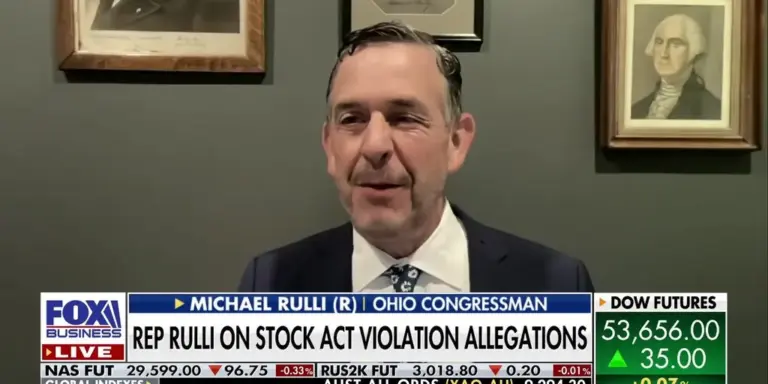
Ohio Congressman Michael Rulli has firmly denied allegations that he violated the STOCK Act, which prohibits members of Congress from using nonpublic information for private profit. The controversy centers on claims regarding his financial disclosures and timing of stock trades, sparking renewed debate over transparency and ethics within the legislative branch. Rulli maintains that all his transactions were handled legally and reported according to federal guidelines.

In a statement addressing the accusations, Rulli emphasized his commitment to following the law and dismissed the claims as unfounded attacks. He argued that any perceived discrepancies in his filings do not constitute a breach of legal requirements but rather reflect standard administrative processes. His office suggested that the scrutiny is politically motivated, aiming to cast doubt on his integrity during a period of heightened sensitivity toward congressional insider trading.

The STOCK Act was designed specifically to prevent lawmakers from leveraging their privileged access to government secrets for personal gain in the stock market. While many representatives have faced similar inquiries over the years, critics argue that enforcement remains lax and penalties are often too small to act as a true deterrent. For Rulli, these latest allegations add him to a growing list of officials under fire as public demand for stricter bans on individual stock ownership among politicians increases.

As the situation develops, it remains unclear whether formal investigations by house ethics committees will be launched into the matter. Supporters of the congressman believe he will be fully exonerated once all documentation is reviewed, while watchdog groups continue to call for more comprehensive reforms to ensure total financial transparency for everyone serving in Washington.

The tech sector is bracing for another wave of volatility as some of the industry’s biggest players prepare to release their latest financial results. Investors are keeping a close eye on Dell Technologies, which has managed to hold its ground despite a historical tendency for sharp price swings following earnings announcements. The company enters this reporting period with significant momentum, though traders remain cautious about how much growth is already baked into the current share price.

While Dell captures attention in hardware, the spotlight shifts toward software giants Snowflake and Palo Alto Networks. Both companies are expected to provide critical insights into corporate spending trends and the continued adoption of cloud infrastructure and cybersecurity tools. Their reports will likely serve as bellwethers for the broader software market, determining whether the recent optimism surrounding enterprise AI translates into tangible revenue growth.

This anticipation comes on the heels of several positive surprises that have already lifted indices like the Nasdaq and S&P 500. Recent wins from Salesforce, CrowdStrike, and Okta, combined with a glowing outlook from Nvidia, have created a bullish atmosphere across the board. However, analysts warn that expectations are now sky-high, meaning even slight misses could lead to quick corrections regardless of overall profitability.

As these remaining firms step into the arena, the overarching theme remains clear: efficiency and artificial intelligence integration. Markets are no longer rewarding simple growth stories; they want to see how legacy providers like Dell and specialized platforms like Snowflake are monetizing new technologies in an increasingly competitive landscape. For now, shareholders are holding their breath while waiting for the numbers to confirm if this rally has real legs.

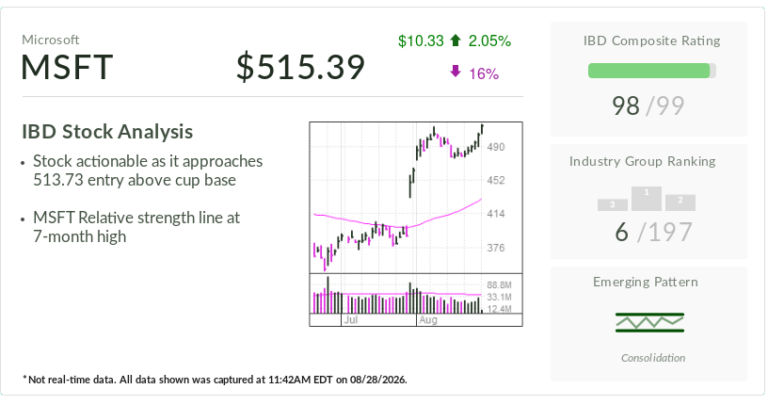
Microsoft has reclaimed the spotlight as the stock of the day after triggering a fresh buy signal that has caught the attention of market analysts. After a period of consolidation, the software giant is showing renewed technical strength, suggesting that investors are once again eager to pile into the company at current valuation levels. This latest momentum comes as traders look for stability amid broader market volatility, positioning Microsoft as a primary target for those seeking growth in large cap equities.

The rally is largely fueled by the conviction that Microsoft remains one of the definitive winners in the artificial intelligence race. While many companies have touted AI capabilities, Microsoft has successfully integrated generative tools across its entire ecosystem, from Azure cloud services to Office productivity software. This deep integration allows them to monetize AI more effectively than most competitors, turning experimental technology into tangible revenue streams that satisfy shareholders.

Industry experts suggest that while some feared an AI bubble, Microsoft’s fundamental infrastructure makes it uniquely resilient. By leveraging its partnership with OpenAI and expanding its own proprietary chip development, the company is reducing dependency on third party hardware while scaling its capacity to handle massive computational loads. As enterprises continue their digital transformations, Microsoft sits comfortably at the center of that evolution.

Ultimately, this new buy signal reflects a belief that there is still significant runway left for the tech titan. Despite its massive size, the ability to consistently innovate and capture new segments of the enterprise market keeps it competitive against both legacy rivals and nimble startups. For now, all signs point toward a continued trajectory of dominance as AI shifts from a buzzword to a core business requirement globally.

The Buffalo Bills wrapped up their 2026 preseason on a high note Thursday, securing a dramatic 28-27 victory over the Pittsburgh Steelers. While the coaching staff kept the starters sidelined to ensure they are fresh for the regular season, the game served as a critical audition for several bubble players. Quarterback Shane Buechele managed the offense effectively, completing 26 of 38 passes for 196 yards, though his modest efficiency may not be enough to climb higher on the depth chart before opening day.

Among the biggest winners of the afternoon was rookie wide receiver Skyler Bell. The fourth round pick looked every bit the versatile weapon Buffalo hopes he becomes, hauling in seven catches and capping off his night with a twenty eight yard touchdown run. His ability to create plays both through the air and on the ground provided a spark for an offense looking to maximize its support system around Josh Allen. Similarly, linebacker Keonta Jenkins made a strong case for his roster spot by leading the team in solo tackles while adding a sack and a tackle for loss during his extended playing time.

Not everyone found success under the lights, however. Veteran receiver Mecole Hardman Jr. struggled to find any rhythm, managing only one catch for two yards in a disappointing showing. On the defensive side of the ball, second year draft pick DeWayne Carter failed to disrupt the Steelers’ interior line, recording just one tackle throughout the contest. These lackluster performances leave both players with plenty of work to do in final practices if they want to secure consistent snaps once games actually count toward wins and losses.

Rounding out the mixed bag was running back Frank Gore Jr., who put together one of his most complete preseason outings yet. Though his rushing numbers were modest, he proved highly reliable as a safety valve in the passing game by catching everything thrown his way for forty five yards and adding a score on the ground. As Buffalo moves into week one with a perfect three zero exhibition record, these flashes of talent among the reserves suggest that while the stars will lead them, there is promising depth waiting in the wings.

Nvidia has long been known as the undisputed heavyweight champion of AI chips, but a closer look at its financial moves reveals a different strategy unfolding behind the scenes. While its massive market capitalization puts it at the top of the global food chain, the company is increasingly acting as a strategic kingmaker through a diversified investment portfolio. Recent filings show that Nvidia holds stakes in everything from SpaceX and Intel to specialized firms like CoreWeave and Synopsys, effectively securing its supply chain and fostering partnerships across foundries, telecommunications, and even generative biology.

Despite this calculated expansion, there is one glaring hole in Nvidia’s current stable of investments: energy. As artificial intelligence continues to scale, the demand for electricity has become a critical bottleneck for the entire industry. Nvidia CEO Jensen Huang has candidly noted that AI requires vastly more power than what is currently available, suggesting that without a sustainable energy revolution, the hardware boom could hit a ceiling. This creates a perfect opening for companies capable of solving the power crisis.

Enter Bloom Energy, a hydrogen fuel cell specialist that has seen its stock skyrocket nearly 2,000 percent over the last two years. The company is positioning itself as a primary solution for AI infrastructure, recently crossing the one billion dollar mark in quarterly revenue and forging a massive twenty five billion dollar partnership with Brookfield Asset Management. Because their technology provides an alternative fuel source for high intensity data centers, Bloom Energy has already gained traction among major US hyperscalers and various AI labs.

While Nvidia does not yet hold a stake in Bloom Energy, many analysts believe such a move would be logical given how Nvidia typically invests in companies that protect its ecosystem. By backing an energy innovator like Bloom, Nvidia could ensure that the physical infrastructure required to run its chips actually exists to support them. If NVIDIA continues its trend of investing in essential utility players within the AI stack, Bloom Energy represents perhaps the most strategic next step toward powering the future of computing.

What began as a massive four billion dollar buyout attempt between Allied Gold and Zijin Gold International has ended in a strategic pivot after the deal hit an insurmountable wall of regulatory obstacles. Rather than proceeding with a full acquisition of the Canadian producer, the two companies have opted for a scaled back partnership involving a 295 million dollar private placement. This new arrangement gives Zijin a 9.2 percent stake in Allied, allowing them to keep a foot in the door of Allied’s African assets without triggering the same red flags as a total takeover.

Industry insiders point toward significant friction within Chinese regulatory bodies as the reason for the collapse, specifically citing difficulties obtaining approval from China’s National Development and Reform Commission. While the loss of a multi billion dollar payout might seem like a setback, market analysts suggest that the smaller equity injection actually serves as a vital stabilizer for Allied’s balance sheet. Coming on top of existing cash reserves, this funding provides a safety net that allows the company to pursue aggressive growth independently.

The shift in strategy comes at a time when Allied is seeing strong internal momentum and updated valuations. Recent projections for the Bonikro project show extended operations through 2036, nearly tripling its estimated asset value according to research from H&P Advisory. These optimistic outlooks are backed by steady second quarter performance, where the company reported net revenues of 427 million dollars and production levels that aligned closely with analyst expectations.

Looking ahead, Allied intends to channel this fresh capital into several key infrastructure plays across Africa. A major priority is the Kurmuk project in Ethiopia, which is scheduled to begin operations this month with initial gold production expected shortly thereafter. Additionally, the funds will be used to expand the Sadiola mine in Mali and ramp up output at the CDI complex in Cote d Ivoire, ensuring that despite the failed merger, the company remains on an accelerated path toward increased annual production.

Chile and Argentina are breathing new life into a decades old treaty to create a massive copper hub spanning the Andes Mountains. In a recent meeting in Santiago, officials from both nations established operational protocols that clear the way for over 20 billion dollars in potential investments. While the Mining Integration and Complementation Treaty was originally signed back in 1997, it remained largely dormant until the current administrations of President Jose Antonio Kast and President Javier Milei decided to revive it this year to capitalize on the global demand for minerals.

The heart of this agreement lies in three specific mega projects known as Vicuna, NexoAndino, and Filo Sur. These deposits sit directly on the border between Argentinas San Juan province and Chiles Atacama region, making shared infrastructure essential for their success. By signing these additional protocols, the two countries have created a legal roadmap that allows companies to move equipment and resources seamlessly across borders. For Argentina, this is particularly transformative as it grants landlocked mines easier access to Chiles sophisticated ports and existing supply chains along the Pacific coast.

Industry leaders believe this cooperation will trigger an economic boom for both neighbors. Joaquin Villarino of Chiles Mining Council noted that binational projects open huge doors for local suppliers and service providers who can now operate across a wider geographic area. On the Argentine side, the push comes at a critical time; the country hasn’t produced copper since 2018, but it is currently entering its most aggressive investment cycle in history thanks to new tax incentives designed to attract foreign capital.

The scale of ambition here is staggering, with some analysts suggesting that total capital absorption across various Argentine developments could eventually reach 44 billion dollars. If these integrated hubs become fully operational, projections suggest Argentina could produce over a million tons of copper annually by 2035. As representatives from major firms like Glencore and McEwen Mining gather to refine these plans, the revival of this old treaty signals a shift toward regional pragmatism aimed at dominating the green energy transition market.

In a strategic move to bolster copper production in South America, Japanese giant Sumitomo and Canadian engineering firm G Mining Group have teamed up to acquire a twenty five percent stake in Tintina Mines. Through a joint venture, the two companies invested thirty four point five million dollars into a larger private placement, providing Tintina with the necessary capital to secure full ownership of the Dos Amigos copper gold project in northern Chile. This financial infusion is intended to drive the project forward until a final investment decision can be reached.

Located in the Atacama Region about one hundred thirty kilometers northeast of La Serena, the Dos Amigos site is poised for significant output. A recent economic assessment suggests the open pit mine could operate for twenty five years, processing thirty five thousand metric tons of material daily. The projections are ambitious, aiming for annual productions of thirty seven thousand metric tons of copper and fifty seven thousand ounces of gold. Because the site sits at a low elevation, it will benefit from utilizing existing power and transport networks already established by nearby mining operations.

For Sumitomo, partnering with G Mining Group is a calculated effort to avoid the costly delays and budget overruns that have plagued many large scale mining ventures globally. G Mining brings a reputation for efficiency and precision, having successfully delivered major sites like Newmont’s Merian mine and Lundin Gold’s Fruta del Norte on schedule. By combining Sumitomo’s capital with G Mining’s operational expertise, the partners hope to streamline the path toward production at Dos Amigos.

This investment arrives amid a broader geopolitical shift as Chile and Argentina work together to unlock billions of dollars in stranded mineral assets along their shared border. Recent diplomatic efforts between Presidents Jose Antonio Kast and Javier Milei have revived a long standing integration treaty designed to share infrastructure across the Andes Mountains. With new tax incentives in Argentina and an influx of projects undergoing environmental review in Chile, the regional climate has become increasingly favorable for massive investments in copper, which remains critical for the global energy transition.

The race to build the infrastructure behind artificial intelligence is creating a new boom for America’s blue-collar workforce, as construction firms scramble to fill jobs building data centers, power systems and the facilities that keep the technology running.

The rapid buildout is putting a new premium on skilled trades, with data centers requiring armies of workers to prepare sites, pour concrete, install electrical systems and handle the infrastructure needed to bring them online.

“For many years, there’s been a lack of focus just in general from what is the benefit of a career in the trades,” explained Cole Renken, general manager of Merlo America, the U.S. division of Italian construction equipment manufacturer Merlo Group.

“It’s a very stable income, very stable lifestyle that you can provide for,” he added.

ONE OF AMERICA’S OLDEST MANUFACTURERS SAYS AI IS CREATING JOBS — NOT REPLACING THEM

Now, the AI infrastructure boom could bring renewed attention to those careers.

U.S. construction spending is projected to climb from $2.22 trillion in 2026 to $2.85 trillion by 2031, according to a new report from Merlo America developed with predictive sales intelligence firm BiltData.ai. Industrial construction, which includes factories and data centers, is projected to reach $684 billion by 2031, representing 24% of total U.S. construction spending.

Much of that growth is being driven by the infrastructure needed to power AI, cloud computing and 5G, with data centers emerging as a major source of construction and industrial activity. And building those facilities requires skilled workers at nearly every stage of a project.

Renken said large projects require heavy-equipment operators to prepare sites and logistics workers to coordinate materials, followed by concrete workers, electricians, plumbers and other skilled trades as construction progresses. Electrical workers, he said, could face particularly high demand.

A SOUTHERN STATE JUST TOOK THE TOP SPOT IN ONE OF THE WORLD’S FASTEST-GROWING INDUSTRIES

And the jobs don’t necessarily disappear once construction is complete.

Brittany Kaiser, CEO of AI infrastructure company Alpha Compute, told Fox News Digital that data centers require workers not only to build the facilities and energy infrastructure, but also to install equipment, monitor operations, perform maintenance and support future expansion.

“These are projects that can provide hundreds or thousands of jobs over many, many years,” Kaiser said. “It’s not a quick construction project.”

She described data centers as “a constant construction project,” requiring workers across construction, electricity, energy development, monitoring and maintenance as facilities grow and expand.

That ongoing demand could create opportunities for surrounding communities, particularly for workers who can be trained for specialized positions.

“It’s jobs that can also be taught and trained,” Kaiser said. “So it’s very possible to engage with the community on education and training initiatives to allow people to get access to these higher paying jobs that they didn’t have a skill set for before.”

But as projects multiply, finding enough skilled workers could become a challenge.

Renken said shortages in the trades have persisted throughout much of his career and could intensify as more projects come online.

The boom, he said, is also a reminder that even the most advanced technology depends on physical infrastructure and the skilled workers needed to build and maintain it. That need, he said, could bring new attention to skilled trades that have long been overshadowed by the focus on high-tech jobs.

“To me, it has been kind of an overshadowed market that hasn’t gotten the attention that it needs,” he said.

A Los Angeles councilwoman’s celebration of a newly painted neighborhood crosswalk has drawn online mockery after critics seized on the months-long timeline and glossy “street infrastructure” rollout for what they said amounted to a basic city service.

Los Angeles Councilmember Nithya Raman, a member of the Democratic Socialists of America, is facing online mockery after celebrating the completion of a neighborhood crosswalk project, which was first raised by the Los Feliz Neighborhood Council late last year, in a post on X. The post featured before-and-after images and thanked her field team for “continuing to problem-solve, push for solutions, and make our streets safer.”

“Dear Lord, Nithya. Your standards are so incredibly low,” responded Richard Grenell, Presidential Envoy for Special Missions amid Donald Trump’s second term. “They didn’t even fix the street, they painted over cracks. And it took them a year…..”

“Holy s—t, my sides…Nithya Raman’s big accomplishment is taking 9 months to paint 7 yellow stripes over a cracked street?” quipped former L.A. mayoral candidate and reality television star Spencer Pratt. “How dumb do you have to be to post this? BAHAHAHAHAHAHAHAHA”

DEM’S MELTDOWN OVER ‘TERRORIST SYMPATHIZER’ HASAN PIKER TRIGGERS INSTANT CONSERVATIVE MOCKERY: ‘YIKES’

“This is beyond parody,” responded conservative commentator Ben Shapiro. “Eight months to paint some yellow lines. Huge infrastructure victory! Make her mayor!”

“They’re calling it the most ambitious infrastructure project since the Golden Gate Bridge,” added the Manhattan Institute’s Chris Rufo.

AOC’S SOCIALIST CREDENTIALS FACE FRESH SCRUTINY AFTER GLARING 7-YEAR GAP SURFACES: ‘VERY CONVENIENT’

Fox News Digital reached out to Raman’s office and Pratt for comment but did not receive a response before publication.

Raman’s announcement labeled the work “Improving Our Neighborhood Street Infrastructure” and included before-and-after photos showing yellow crosswalk markings across the cracked roadway. She said the Los Feliz Neighborhood Council had brought the issue to her office in late 2025.

The post did not specify the project’s cost, when physical work began, which city department performed it or whether the work involved safety improvements beyond the painted markings.