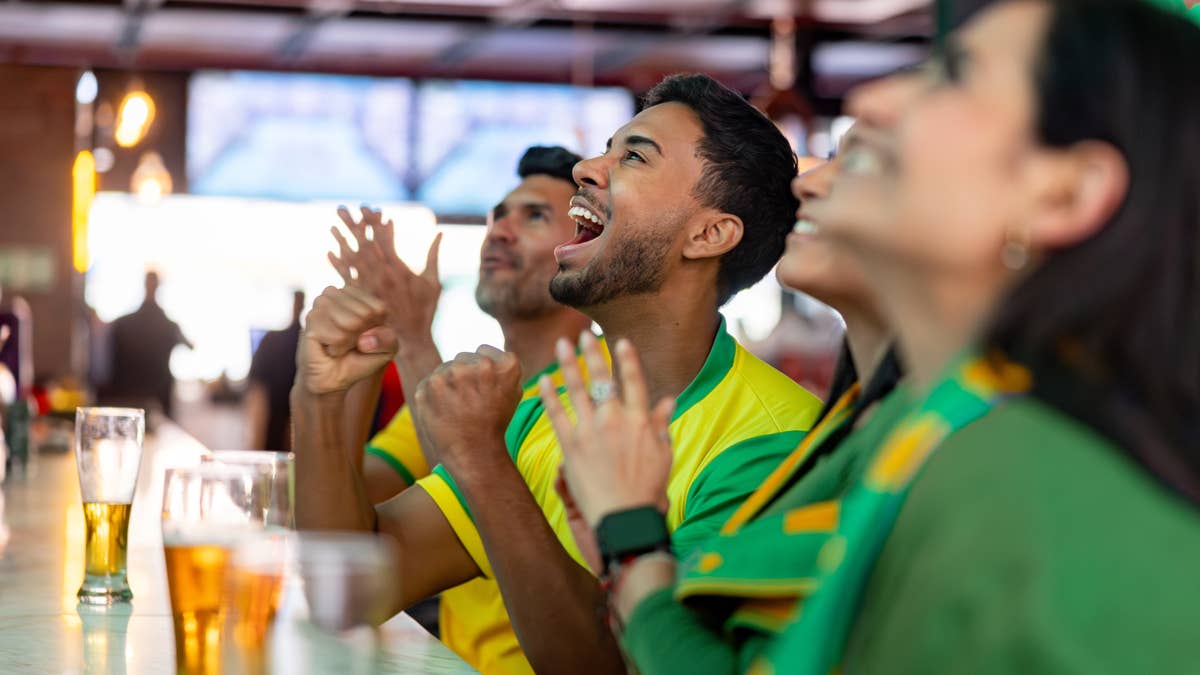
Wall Street loves a catalyst, and while earnings dates can slip and Federal Reserve meetings disappoint, a global sporting event shows up exactly on schedule, with billions of eyeballs and a thirst to match.
For the beverage business, no date on that calendar is bigger than the World Cup. This year’s edition is the largest ever staged, with 48 teams and 104 matches spread across the United States, Canada, and Mexico.
Brewers planned for this summer the way retailers plan for Christmas. Anheuser-Busch InBev (BUD) signed on as the tournament’s official beer sponsor, rivals wrapped cans in national colors, and analysts penciled the party into their models before a single ball was kicked.
The assumption underneath all of it was simple. Fans drink when their team plays, and they drink far more when their team keeps winning.
That assumption ran into a wall on the night of July 5. Two results, a few hours apart, knocked out the two most reliable beer-drinking fan bases in the tournament. By the morning of July 6, Morgan Stanley was telling clients that the great beer boom of 2026 had sprung a leak, and investors spent the rest of the session repricing the damage.
Why the World Cup matters so much to beer companies
The link between soccer and beer sales is one of the most dependable relationships in consumer finance. Jefferies analysts projected the 2026 tournament would drive the additional consumption of “more than 1 billion cases of beer globally,” according to Funds Society, enough to lift the sector’s annual volume by 0.2 to 0.3 percentage points.
Those cases were never going to be spread evenly. The biggest spikes come from countries where soccer is a religion and beer is the sacrament, which is why Brazil and Mexico sat at the center of every model. Mexico is the world’s largest beer exporter, and Brazil ranks among the largest beer markets anywhere.
More Wall Street:
- Wall Street’s $200 billion IPO wave threatens sell-off
- J.P. Morgan unleashes $50 billion buyback after stress test
- Bessent doubles down on Main Street over Wall Street
The corporate map matters here. AB InBev owns Corona, Modelo, and Brazil’s Skol globally, while Constellation Brands (STZ) holds the lucrative U.S. rights to Corona and Modelo.
Heineken (HEINY) runs major brewing operations across Mexico, which means all three companies drew up 2026 plans with the same two fan bases at the center.
The money followed the models. Morgan Stanley itself estimated that advertising activity tied to the tournament could top $500 million, with roughly 44% of U.S. consumers planning to engage with the event, according to the same Funds Society report.
The industry needed this tournament, too. Beer volumes have been soft for two years as drinkers trade down and younger consumers cut back, so a once-in-a-generation home-continent World Cup looked like the closest thing to a guaranteed win the sector had left.
Related: Heat wave leads popular tourist destination to add new alcohol rule
Morgan Stanley sees a hole in beer’s biggest quarter
Third-quarter sales in Latin America now risk falling short of expectations after Brazil and Mexico were eliminated within hours of each other on July 5, Morgan Stanley analysts led by Sarah Simon warned in a note to clients, Bloomberg reported.
The carnage on the field was swift. Brazil fell 2-1 to Norway in East Rutherford, N.J., undone by “an Erling Haaland brace and a brilliant Orjan Nyland display,” according to FIFA. It was the first time the five-time champions missed the quarterfinals since 1990.
Hours later, Mexico lost 3-2 to England at Estadio Azteca, the team’s first World Cup defeat ever at its fortress stadium, on a Jude Bellingham double and a Harry Kane penalty.
Morgan Stanley’s logic is blunt. “We believe the concentration of the beer volume uplift comes from ‘deep run’ games,” the analysts wrote in the note, according to Bloomberg.
Group-stage matches sell some beer. A home nation marching toward the July 19 final at MetLife Stadium sells oceans of it, and both of those oceans just evaporated.
The bank called AB InBev the most exposed name given its dominance in both Mexico and Brazil, with Heineken carrying meaningful exposure of its own, according to the same report. Brazil’s exit stings more than Mexico’s, the analysts added, because its beer market is bigger and expectations ran higher.
Investors did not wait for the fine print. Here is how the July 6 session shook out:
- Constellation Brands fell 4.9% to its lowest close since Nov. 20, according to Bloomberg.
- Ambev (ABEV), AB InBev’s Brazilian subsidiary, closed 2.5% lower in São Paulo, according to Bloomberg.
- Boston Beer (SAM) and Molson Coors (TAP) also finished the day in the red, according to Bloomberg.
- The S&P 500 rose 0.72% in the same session, according to Barchart.
That last line is the one that caught my attention. I compared the beer names against the tape, and this was a targeted, stock-specific punishment delivered on a day the broader market rallied.
Traders were not selling risk. They were selling this exact story.
One detail worth keeping straight is that the analysts framed the damage as growth that now simply will not show up, rather than existing sales going backward. That is cold comfort for a sector priced for a boom.
What beer investors should watch next
The note’s built-in silver lining lasted less than a day. Morgan Stanley pointed to a deep run by the U.S. team as a potential offset, and on the night of July 6, Belgium dismantled the Americans 4-1 in Seattle.
The U.S. team’s “hopes for a deep World Cup run at home ended,” according to ESPN. All three host nations are now out of their own tournament, an outcome no beer model anywhere had penciled in.
My analysis of the remaining bracket suggests the volume story now tilts toward Europe. England, which faces Norway in Miami Gardens on July 11, is a heavyweight beer market, and a European-flavored final helps Heineken’s home turf far more than it helps the Mexico-and-Brazil engine that powers AB InBev and Constellation.
The bank has been busy handicapping World Cup winners and losers all year, from its bullish Monster Beverage call to its DraftKings forecast built partly on tournament betting volume. The beer note is the first time it has told investors the tournament may take more than it gives.
The scoreboard that matters next is the earnings calendar. Constellation heads into its next report sitting at levels last seen in November, and AB InBev’s third-quarter numbers this fall will reveal exactly how many of those 1 billion projected cases were poured.
Twelve days of soccer remain, and some of the biggest television audiences of the year are still ahead. The question for beer investors is no longer how big the party gets. It is who is left standing at the bar when the tab arrives.
Related: The World Cup may be about to get a lot bigger