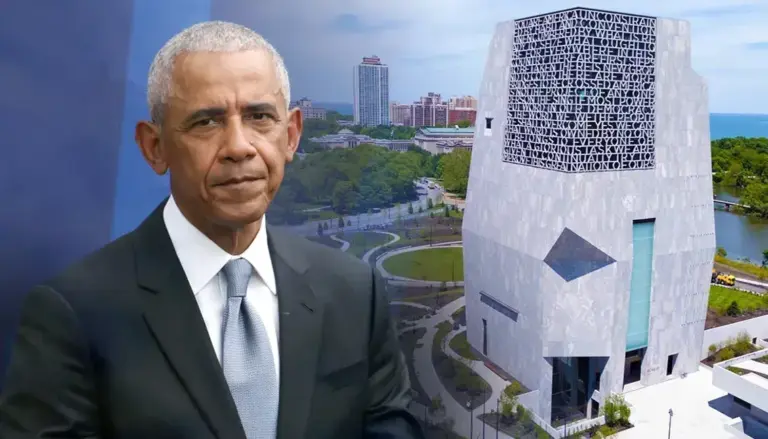
FIRST ON FOX – The price tag for the beleaguered Obama Presidential Center is now projected to top $1 billion, nearly triple its original estimate, the foundation overseeing construction of the Chicago facility told Fox News Digital.
Confirmation of the 10-figure cost marks another chapter in the troubled history of the much-delayed project, which opened five years behind schedule amid controversy over its use of public parkland and claims that subcontractors were stiffed out of millions of dollars. It comes as newly released financial records reviewed by Fox News Digital offer a fresh look at the finances of the Obama Foundation, the former president’s private nonprofit that oversaw construction of the billion-dollar project.
The sprawling campus on the Windy City’s south side was originally expected to open in 2021, with construction costs estimated at $300 million to $350 million. But years of federal reviews, legal challenges and construction delays preceded its eventual opening in June 2026, by which time projected costs had skyrocketed to approximately $850 million.
Hailed by Democrats and supporters as a historic investment in the community and a tribute to the former president’s legacy, the center was promoted as a catalyst for jobs, economic growth and new opportunities for underserved communities.
BUREAUCRATS HIDE TRUE PRICE OF OBAMA PRESIDENTIAL CENTER AS TAXPAYERS HIT WITH INFRASTRUCTURE BILL
“While we continue to reconcile costs and plan ahead for additional capital improvements, we anticipate our total cost for constructing the campus is approximately $1 billion — again, all raised in private contributions,” Emily Bittner, the Obama Foundation’s vice president of communications, told Fox News Digital. “This includes investments in additional public art, insurance, scope changes in our Home Court, project management and exhibit installation, among other categories.”
The campus serves as both a museum dedicated to Obama’s presidency and the headquarters of the Obama Foundation. It also features a public library branch and an athletic center, but unlike traditional presidential libraries, it does not house his original presidential records, although digital versions and artifacts are featured in its museum.
Inside the Obama Foundation’s finances
The climb toward the $1 billion mark has seemed inevitable in recent years, with approximately $909 million in construction-related costs recorded by the end of 2025, when the project was about 80% complete, according to its newly released audited financial statements.
The Obama Foundation’s newly released financial disclosures cover the nonprofit’s entire operation, not just the Chicago campus. It also runs leadership, education and community programs across the United States and around the world.
The tax filings show donations and grants fell to approximately $151 million in 2025, down from $195 million in 2024. Fundraising has fluctuated sharply in recent years, falling from $311 million in 2022 to $129 million in 2023 before rebounding in 2024 and declining again last year.
OBAMA PRESIDENTIAL CENTER SUBCONTRACTORS FILE FRESH PAYMENT CLAIMS TOTALING NEARLY $900K
Total liabilities climbed to approximately $103.5 million in 2025, during the final stages of the center’s construction, up from $35 million in 2024 and $20 million in 2022.
The Obama Foundation’s outstanding borrowing also rose from $15 million at the end of 2025 to approximately $63.5 million by July 2026, according to its audited financial statements. The nonprofit said it borrowed the money to cover short-term costs during the final stages of construction and that the loans were not secured against its rights to the property.
Its money and investments available to cover everyday expenses also fell from approximately $265 million in 2024 to $101 million in 2025.
Brian Mittendorf, a nonprofit accounting professor at the Ohio State University who reviewed the Obama Foundation’s tax filings and audited financial statements, said the nonprofit remains on solid financial footing, with more than $1.1 billion in net assets at the end of 2025.
“In terms of the organization’s overall financial health, again, I would say financial health looks quite good,” Mittendorf told Fox News Digital. “They have a decent amount of cash, investments, liquidity, and so on. So it’s not like they’re in financial difficulty by any means.”
However, he noted that much of the foundation’s wealth is tied up in the Presidential Center, rather than assets that could readily be converted into cash.
“Bottom line to me: I don’t see a short-term financial distress here, but I do see an organization that has tied up a lot of its resources in its buildings, which means more costs to come and the need for more revenues to make this sustainable,” he said.
OBAMA CENTER SUBCONTRACTOR SHUTS DOWN AMID $4M FIGHT, LAYS OFF 25
Mittendorf warned that raising money to maintain the sprawling campus could prove more challenging than funding its construction.
“It’s much easier to raise money when it’s for building a building than it is for doing upkeep or paying for insurance or paying utilities,” he said.
Obama Foundation officials said its operating costs are covered by revenue and private donations, although they did not provide a figure for the center’s annual operating and maintenance expenses.
The Obama Presidential Center sits on 19.3 acres of historic public parkland in Jackson Park. It secured the site through a 99-year agreement with the city for a one-time payment of just $10.
While the foundation funded construction, the land and buildings are legally owned by the City of Chicago.
The $470 million safety net
Critics have long raised concerns over the foundation’s failure to fully fund a proposed $470 million endowment — a financial safety net designed to generate income for the center’s upkeep and reduce the risk of taxpayers footing the bill if the project runs into trouble.
A previous Fox News Digital investigation found that just $1 million had been set aside for years. Newly released financial statements show the Foundation’s overall endowment grew to approximately $14.2 million by the end of 2025, although it remains unclear how much of that money is specifically reserved for the Presidential Center.
Obama Foundation officials said the agreement with the city of Chicago required them to establish an endowment, not fully fund it, before taking control of the site. They said they prioritized fundraising for construction and leadership programs and that they plan to make significant investments in the fund in the coming years.
Richard Epstein, a New York University law professor who has advised opponents of the project, disputed the Obama Foundation’s interpretation, arguing that establishing an endowment without adequately funding it defeats its purpose.
“Otherwise, they provide no protection,” Epstein told Fox News Digital, arguing that under the Obama Foundation’s interpretation, “they could list the endowment as $1 billion and fund it with ten cents.”
Subcontractors still seeking payment
Despite the foundation’s substantial assets, some of the subcontractors who helped build it say they are still fighting to recover millions of dollars in disputed payments. A previous Fox News Digital investigation identified several firms claiming major financial losses, including minority-owned businesses the project was intended to support.
Mike Owen, owner of Chicago-based Adamson Plumbing, said his company suffered nearly $4 million in losses tied to the project, forcing him to suspend operations and lay off 25 union workers. His company subsequently filed a $1.72 million mechanics lien seeking payment for disputed work.
Owen told Fox News Digital this week that he still has not recovered the money he is seeking.
The Obama Foundation previously said Lakeside Alliance, the project’s construction manager, was responsible for managing and paying subcontractors and that the foundation had no outstanding disputed charges with the alliance. Lakeside Alliance has said contractual closeout on a project of this scale can continue long after opening and that it remains committed to resolving outstanding matters.
What did $1 billion build?
The campus features a museum dedicated to Obama’s presidency, housed in a 225-foot-tall, eight-story tower, along with a branch of the Chicago Public Library, a children’s playground, an auditorium, conference and meeting spaces, public gardens and more than 20 commissioned art installations.
At the southern end of the campus sits Home Court, a 60,000-square-foot athletic and community center, featuring a regulation-size NBA basketball court, training facilities and multipurpose rooms for meetings and events.
The Obama Foundation, which is headquartered at the center, also runs leadership, education and community programs in the United States and around the world, including initiatives to train emerging leaders, support young people and encourage civic engagement.
Obama’s original presidential records are instead stored at the National Archives in College Park, Maryland, rather than at the Chicago campus, which is not part of the federally operated presidential library system.
Critics have long questioned why the city granted control of valuable public parkland for a privately operated museum and foundation headquarters rather than a traditional presidential library, although the plans were approved by the Chicago City Council and the Chicago Plan Commission. The arrangement faced years of legal challenges that ultimately failed to stop construction, although opponents maintained that the courts never ruled on the merits of their central argument that the use of public parkland violated Illinois’ public trust doctrine.
The foundation has promoted the center as far more than a museum, describing it as a place to develop future leaders and inspire change around the world.
WATCH: Presidential historian Tevi Troy says Obama Center is partly an ‘activism center’
Texas’ Democratic Senate candidate James Talarico dismissed his past comments referring to God as “nonbinary” and using the Bible to justify his pro-choice stance on abortion during a Wednesday night CNN town hall.
Participating in a “Jubilee”-style town hall in which voters confronted him one-on-one, Talarico met with a fellow Christian from Texas who pressed him on his past statements.
“You’ve said some concerning things in the past kind of related to faith and social issues. Things such as God is nonbinary, questions about how many genders there really are and your justifications using the Bible for abortion,” Sarah Gardner, a small business owner, said to Talarico.
TALARICO SAYS HE ‘HATES CHRISTIANITY’ IN UNEARTHED INTERVIEW WITH TRANSGENDER ‘LATINX’ THEOLOGIAN
“And so, I think that’s led a lot of Christian voters to question the authenticity of your faith. And I wanted to ask you a very direct question. Do you believe that the Bible is the absolute source of truth and God’s final authoritative word, even when our culture says otherwise?” she asked.
“Yes,” Talarico replied. “And I think it’s important to remember that even the early church, the disciples who actually knew Jesus of Nazareth, the early church, we often talk about as a singular body when, in reality, was more like early churches because there was a lot of disagreement, there was a lot of debate.”
TED CRUZ, CONSERVATIVES RESPOND AFTER TALARICO CRITICIZES BIBLE-RELATED EDUCATION IN SCHOOLS AS ‘PROPAGANDA’
Talarico then went on to explain his past comments as being “provocative,” drawing a parallel to his own interpretation of scripture to Charlie Kirk’s.
“I actually want to clarify a few of the things that you said, because I know that this has been used in these attack ads all over the state,” he began.
UNEARTHED CLIP SHOWS TALARICO CALLING PARENTS ‘ABUSIVE’ FOR DENYING CHILDREN’S GENDER IDENTITY
“The first comment about God not being defined by gender, when I said that I was being provocative. And I want to admit that and come clean about that. But I think what I was saying is actually not controversial theologically. The idea that we can’t define God using human categories, not only did I say that, but the late Charlie Kirk said that, the late Pope Benedict said that. And so, yes, I was doing it, maybe in an annoying way, I can admit that,” he said.
Talarico, a state senator in Texas, previously said, “God is both masculine and feminine, and everything in between. God is nonbinary. In Genesis 1:26, God speaks of God’s self in the plural, saying, ‘Let us make man in our image.'”
EXPERT TEARS APART TALARICO’S VIRAL CLAIM HIS AGENDA IS BASED ON JESUS’S TEACHINGS: ‘BUTCHERING THE BIBLE’
He also dismissed the notion that the Bible refers to abortion.
“The idea that there is a set Christian orthodoxy on the issue of abortion is just not rooted in Scripture,” he said during a 2025 appearance on The Joe Rogan Experience.
Fox News Digital reached out to the Talarico campaign for further comment.
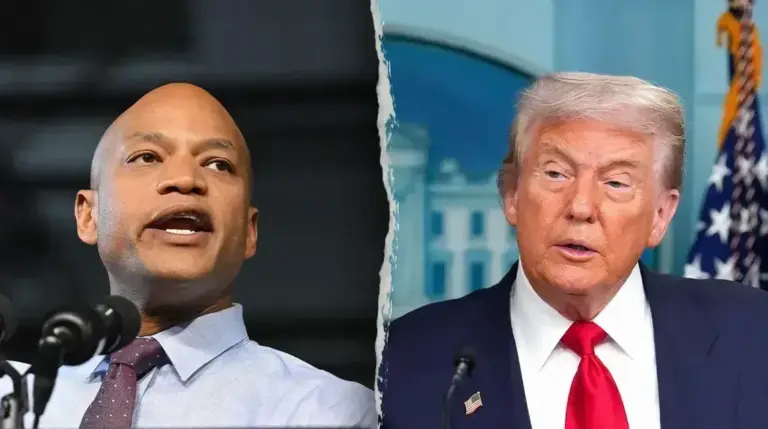
A coalition of prominent press freedom organizations that have blasted President Donald Trump’s treatment of journalists is now accusing Democratic Maryland Gov. Wes Moore, a Trump critic himself, of retaliating against news outlets scrutinizing his administration.
The accusations came in an Oct. 13 letter from the Freedom of the Press Foundation and six other journalism and civil liberties organizations. The groups raised concerns about the Moore administration’s decision to subject even routine inquiries from reporters at Sinclair-affiliated news outlets and The Baltimore Sun to additional legal review.
The additional review came amid a defamation lawsuit filed against Moore by David Smith, executive chairman of Sinclair Broadcast Group and majority owner of The Baltimore Sun. Maryland agencies have explicitly cited Smith’s lawsuit in written responses to reporters, informing journalists at Sinclair-affiliated outlets that their inquiries would be referred to legal counsel before receiving a response.
Moore himself has previously criticized Trump’s treatment of journalists. During a Sept. 20 appearance on CNN’s “State of the Union,” the Maryland governor condemned the president’s decision to bar reporters from CNN, MS NOW and Politico from the White House, accusing Trump of treating the Constitution “like it is a suggestion box simply because he does not like the coverage.”
WHITE HOUSE WON’T BACK DOWN AS ATTORNEY PREDICTS HOW TRUMP’S LATEST PRESS TUSSLE WILL PLAY OUT IN COURT
“It’s particularly offensive that Moore seeks to boost his national profile by slamming the Trump administration’s unconstitutional attempts to ban disfavored media outlets from the White House when he’s engaged in such similar antics himself,” Seth Stern, chief of advocacy at the Freedom of the Press Foundation, said in a statement accompanying the letter.
The press freedom groups that joined in condemning Moore, including the Committee to Protect Journalists, PEN America, Reporters Without Borders and the Society of Professional Journalists, argued that journalists should not face different treatment from government officials because of a dispute involving their outlets’ ownership, drawing a comparison to the Trump administration’s restrictions on certain White House reporters.
Moore’s office strongly disputed the allegations in a statement to Fox News Digital on Wednesday, insisting that reporters have continued receiving responses from state agencies despite the additional legal scrutiny.
BALTIMORE SUN OWNER THREATENS MD GOV WES MOORE WITH LAWSUIT OVER WHAT HE CALLS A DEFAMATORY EPSTEIN LINK
“The central premise of this letter is completely false. There is no blanket refusal to engage,” Ammar Moussa, Moore’s senior press secretary and director of media strategy, told Fox News Digital. “In the last week alone, state agencies and the Governor’s Office have answered dozens of questions from Sinclair outlets, and we’re happy to let them share those responses.”
“David Smith chose to sue the Governor. Having our legal team look over inquiries is basic due diligence, not a blackout,” Moussa continued. “A litigant doesn’t get to dictate how the state protects itself, but that hasn’t stopped our agencies from doing their jobs for the people of Maryland.”
The dispute traces back to a defamation lawsuit Smith filed against the governor in July. Smith accused Moore of making false and damaging statements about him during a television interview, including remarks Smith interpreted as suggesting he had ties to convicted sex offender Jeffrey Epstein.
Smith, whose media holdings include The Baltimore Sun, has been a frequent target of criticism from Moore, who has accused the newspaper’s ownership of advancing a political agenda aligned with Trump. Smith maintains that the governor’s remarks crossed the line from political criticism into defamation.
The lawsuit was filed by Smith personally, rather than the news organizations whose reporters have since faced additional legal review of their inquiries.
SIGN UP TO GET THE POLITICS NEWSLETTER
“We urge you to instruct all Maryland agencies that Smith’s lawsuit against you is a personal matter and not an excuse to send media requests into a legal review black hole, and to cease any other unlawful retaliation against news outlets you personally dislike,” the coalition letter stated.
“It is particularly jarring that, while government agencies under your watch stonewall reporters based on flimsy pretexts, you take to the airwaves to condemn the Trump administration’s unconstitutional ban of news outlets the president doesn’t like from the White House,” the letter continued. “Yes, Trump frequently turns his personal grudges into censorial government policy, to the detriment of the public. But your own conduct appears not much different.”
Tensions flared on the debate stage Wednesday night, where Rep. Mike Lawler, R-N.Y., faced off against Democrat military veteran Cait Conley to represent their suburban New York district in Congress.
Lawler is vying for a third term representing the Empire State’s 17th Congressional District.
One of the few swing seats left in Congress, the race could prove decisive for which party controls the House of Representatives for the latter half of President Donald Trump’s term.
Below are some of the most dramatic moments during their one-hour head-to-head on PIX11 News:
HOW ONE NYC SUBURB COULD DECIDE WHICH PARTY CONTROLS THE HOUSE
Lawler calls out moderator for ‘focus on gangbanger’ shot by ICE
While the debate was filled with the two political rivals criticizing each other, one tense moment came when Lawler turned his ire on moderator Dan Mannarino.
Mannarino had asked both Conley and Lawler what should be done to rein in Immigration and U.S. Customs Enforcement (ICE) agents who run afoul of their own guidelines, invoking the recent shooting of an illegal immigrant in the Bronx by federal officers while the man’s 5-year-old was in the car.
Lawler pointed to the man’s rap sheet and accused Democrat state leaders of creating the situation with their sanctuary policies and Gov. Kathy Hochul’s recent bail reforms. He also accused Conley of supporting those policies.
The moderator began, “Mr. Lawler, I just want to follow up. The question was, how do you ensure if ICE agents do not follow through objectives, and what’s the discipline —”
“I understand the question,” Lawler said amid the cross-talk.
PROTESTS ERUPT IN THE BRONX AFTER ICE AGENT SHOOTS MAN DURING IMMIGRATION OPERATION
“But you didn’t answer the question,” Mannarino said.
“I understand the question. But here’s the problem, Danny,” Lawler shot back. “You guys want to focus on a gangbanger who has put people in harm’s way? I want to make sure that our communities are safe.”
ILLEGAL IMMIGRANT ACCUSED OF MURDERING COLLEGE STUDENT DIALS INTO HEARING FROM HOSPITAL BED
Lawler and Conley clash over Sheridan Gorman’s killer
The GOP incumbent notably used the immigration standoff to pivot to the case of Sheridan Gorman, a teen from his district who was shot and killed near her college campus in Chicago earlier this year. The accused is an illegal immigrant who was previously arrested for shoplifting but was never turned over to ICE due to Chicago’s sanctuary policies.
Conley called Gorman’s death an “atrocious crime,” while Lawler repeatedly said over her, “It was preventable.”
SHERIDAN GORMAN’S MOM SCORCHES DEM LAWMAKERS SHE SAYS REFUSED TO HEAR FAMILIES OF SLAIN AMERICANS
“Can I finish?” an irate Conley shot back. “It was an atrocious crime committed in Chicago. And that man should have been deported. And I do support federal agents and federal law enforcement, federal immigration enforcement, making sure that we deport violent criminals.”
Lawler then pointed out, however, that the man would only have been deported if the sanctuary laws were not in place — laws he has repeatedly accused Conley of supporting along with her fellow Democrats.
“This is important,” Lawler began as the moderator tried to regain control. “If you think he should have been deported when he was arrested for shoplifting, he should have been turned over to ICE. Under the new law that you support, he will not be turned over to ICE, and he will be released under cashless bail.”
“Mr. Lawler, there’s not a cross-examination round, so thank you,” the moderator said.
Conley quipped at her GOP rival, “If you wanted to be the moderator, you should have volunteered.”
Conley accuses Lawler of ‘mansplaining’ on sexual assault
At another point, the candidates were asked whether there should be a federal definition or law for consent to help stop sexual assault.
Conley took the moment to attack Lawler for being allied with Rep. Max Miller, R-Ohio, a fellow House Republican who has been accused of domestic violence by his wife. Miller has denied the allegations.
Lawler said their matter was “tragic” and should be dealt with in family court without blaming either side. He then accused Conley of taking money from former New York Gov. Eliot Spitzer, who was revealed to be a client in a 2008 federal probe into a prostitution ring. Spitzer was never criminally prosecuted and resigned from his governorship amid the scandal.
“I’m sorry. I do not need — I do not need you to mansplain to me, domestic abuse and sexual assault against women,” Conley snapped. “Don’t start. I do not need you to mansplain to me, Mike.”
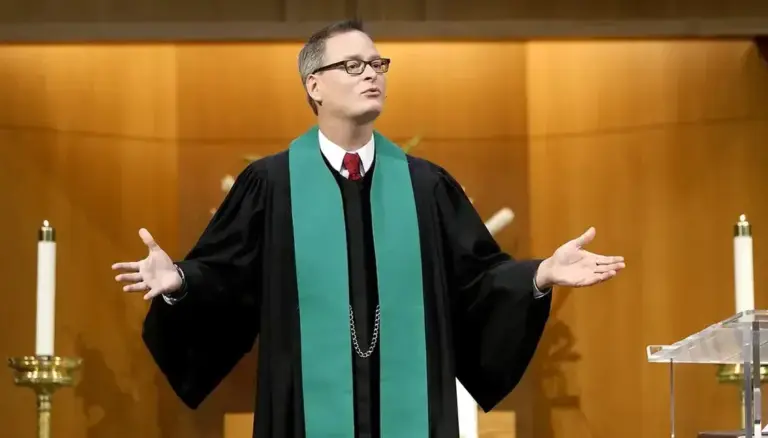
A former pastor and candidate running to make history in deep-red Kansas once suggested that people should repent for their White privilege as protests against the death of George Floyd rippled through the country.
During the tumultuous summer of 2020, just days after Floyd’s killing in Minnesota, Adam Hamilton called on his congregation at the Church of the Resurrection to recognize their White privilege and repent.
“Like part of what I know is that, is that I grew up in a way that I’m blind to certain things in our society,” Hamilton said during a sermon dubbed “Jesus, Protests and Repentance.” “I just am. And I have certain benefits by virtue of being educated, White and male, right?”
KANSAS DEMOCRAT BEGS KAMALA HARRIS NOT TO CAMPAIGN WITH HIM, ‘PLEASE DO NOT COME TO MY STATE’
“And we don’t like to hear that, especially White folks don’t like to hear that. But there are benefits that come along with that,” he continued.
Hamilton is running against Sen. Roger Marshall, R-Kan., in what has become one of the tightest races of this midterm cycle, despite Kansas’ near-century-long history of not sending a Democratic candidate to the Senate.
“Roger Marshall wants to talk about anything other than his history of suing and jailing mothers and protecting predators by voting against releasing the Epstein Files,” Tyson Brody, a spokesperson for Hamilton’s campaign, told Fox News Digital. “Once again, he’s attacking Adam for something Roger said himself. Roger’s own pastor called Adam ‘middle of the road.’ Kansans are tired of high gas and grocery prices and ready for a senator who won’t divide us by race, religion, income, or ability to pay a medical bill at 18% interest.”
Republicans acknowledge that they are facing headwinds going into November’s election, but until recently, the contest between Marshall and Hamilton wasn’t of much concern for the GOP.
SCHUMER WARNS OF REPUBLICAN ADVANTAGE THAT COULD CHANGE THE BATTLE FOR SENATE CONTROL
Now, the race has taken a turn and been rated a toss-up by the Cook Political Report as voters fume over the cost of fuel, groceries and other economic pain. In response, national Republicans are beginning to dump more resources into the contest to ensure that they maintain the seat.
Throughout the race, Marshall has largely aligned himself with President Donald Trump, only rarely breaking from the administration on certain decisions — last month he called for more advance notice and cooperation between the Department of Homeland Security (DHS) and the Kansas government after federal immigration agents descended on the southern part of the state.
Marshall has painted Hamilton as a “woke” megachurch pastor, delivering left-leaning ideals from the pulpit.
‘JESUS WAS A RADICAL’: PROGRESSIVES INVOKE CHRIST TO SELL LEFT-WING AGENDA ON CAMPAIGN TRAIL
So has an outside group based in Massachusetts, the Main Street Fund, which ran an ad in Kansas that spliced portions of two different sermons and charged that Hamilton was “way too woke for Kansas,” shortly after Hamilton won his primary, The Kansas City Star reported.
During the sermon from June 2020 amid the Black Lives Matter (BLM) protests, Hamilton pushed back against rioting and looting, and argued that while the BLM movement was the focal point at the time, all lives matters.
“Of course all lives matter,” Hamilton said. “Everybody understands white lives matter, blue lives matter.”
Hamilton continued in his sermon posted on the church’s YouTube page in June 2020 amid the Black Lives Matter protests, “When I’m stopped by the police, I’m never afraid that they’re gonna pull a gun on me.”
“But every African American man that I know is worried about what might happen when a police pull him over,” Hamilton said at the time. “It’s not that all the police are bad, they’re gonna do something like that, but there’s this fear underneath there. And so the hands go on the steering wheel at 10 and 2. They’ve been taught that from the time they were children. Right?”
“I wasn’t taught that, because I don’t have to be afraid of that. Right? And there’s a whole host of other things that are just a part of life. You know, I can … well, you get the idea. There are benefits and privileges to my place in life. I have to recognize that,” he continued. “To see that. And then I have to listen. I have to listen and understand, and finally be able to see the brokenness in myself, and my indifference. Before I can do anything to help anyone else, I have to have a conversion. I have to repent.”
And Marshall, who was running for his first term in the Senate at the time, struck a similar somber tone as Hamilton six years ago.
In various posts to social media and interviews with local outlets, Marshall condemned Floyd’s slaying and pushed for reforms that would ensure what happened in Minnesota and to federal Protective Services Officer Patrick Underwood, who was killed in a drive-by shooting just days after Floyd’s death.
“Additionally, Republicans called on Congressional Democrats to work across the aisle to make sure that what happened to George Floyd and Patrick Underwood never happens again, and significant bipartisan reform can be passed,” Marshall said on Facebook following a House Judiciary hearing on police practices and law enforcement accountability.
This post appeared first on https://www.foxnews.com