Author

admin

Browsing

SpaceX hit a major milestone on September 28 when its massive Starship rocket reached orbit for the first time and successfully deployed a batch of satellites. During the fourteenth test flight, the towering 407 foot vessel delivered 26 Starlink Version 3 satellites into low Earth orbit. Onboard cameras captured dramatic footage of the deployment, showing the satellites emerging from the ship like pieces of candy from a Pez dispenser, marking a transition for Starship from an experimental prototype to a productive cargo hauler.

These new Version 3 satellites represent a significant leap in technology over previous generations. Weighing roughly 4,400 pounds each, they are twice as heavy as their predecessors and far too large to fit on the company’s reliable Falcon 9 rocket. Beyond their size, they offer staggering performance boosts, including a tenfold increase in downlink capacity and an uplink capacity that is twenty two times greater than Version 2 models. This efficiency allows SpaceX to pack significantly more data capability into every single launch.

The successful mission paves the way for an incredibly ambitious expansion plan led by CEO Elon Musk. The goal is to eventually build a constellation of around 100,000 Starlink V3 satellites, requiring nearly 1,700 launches just to establish the initial network. Even more daring is the vision for Starmind AI data centers in orbit and a target of 10,000 flights per year by 2030. Such a rapid pace would rely entirely on Starship being fully and quickly reusable, shifting the paradigm of how often humanity accesses space.

While this flight proves Starship can handle heavy lifting in orbit, several hurdles remain before it can take humans to deeper destinations. To reach the moon or Mars, SpaceX must still demonstrate orbital refueling capabilities. Additionally, since Starship is vastly larger than the current Crew Dragon capsule used for astronauts, the company needs to develop and test complex life support systems scaled for such a massive vehicle. Despite these challenges, today’s victory brings those futuristic dreams one giant step closer to reality.


Former Transportation Secretary Pete Buttigieg is sounding the alarm over the Trump administration’s decision to roll back fuel economy standards, arguing that the move could ultimately cost drivers more money and weaken the standing of American automakers on the world stage. In a recent conversation with NPR, the Democrat challenged the official narrative from the Transportation Department, which suggests that easing these requirements will lower the upfront sticker price of new vehicles by roughly thirteen hundred dollars.

Buttigieg pointed out a critical flaw in those calculations, noting that while buyers might save initially, they stand to lose significantly more at the pump. According to government estimates, drivers could face sixteen hundred dollars in additional fuel costs over the lifetime of a vehicle. He argued that these projections likely underestimate the true financial burden on consumers, especially when factoring in volatile gas prices and potential tariffs impacting the automotive sector.

The debate centers on Corporate Average Fuel Economy standards, which mandate that manufacturers hit specific efficiency benchmarks across their entire fleet of cars. While many American automakers have praised the rollback as a way to better align production with current consumer preferences, Buttigieg reminded listeners that the industry has a long history of resisting stricter regulations only to adapt successfully once they are implemented.

Beyond the immediate cost to consumers, Buttigieg warned that loosening these rules creates a strategic vulnerability for the United States. By reducing the pressure to innovate and transition toward more efficient technology, he believes the U.S. is effectively handing a competitive edge to China. As Beijing aggressively expands its electric vehicle industry and seeks a dominant share of the global market, any slowdown in American innovation could prove costly for domestic manufacturing in the long run.

The Dow Jones Industrial Average faced downward pressure during Tuesday trading as investors reacted to a volatile mix of economic indicators and surging government debt costs. Markets felt the weight of a key Treasury yield climbing to its highest level in twenty four years, creating an environment of uncertainty that dragged down the blue chip index even as other major benchmarks remained mixed heading into the closing bell.

Much of the day’s movement was driven by fresh data regarding consumer confidence and the state of the labor market, leaving traders to weigh whether current trends signal resilience or overheating. While the Dow struggled to maintain its footing, it did manage to recover slightly from its intraday lows, suggesting some late session support despite the overarching headwinds caused by rising yields.

Amidst the broader volatility, specific growth names continued to attract attention from active traders looking for strategic entry points. Tech giant Nvidia and energy player Bloom Energy both emerged as notable equities testing levels that could offer attractive buying opportunities for those betting on long term artificial intelligence and green energy trends.

As Wall Street digests these latest shifts, all eyes remain fixed on upcoming corporate catalysts including earnings reports from semiconductor heavyweights like Micron. These results are expected to provide further clarity on whether the appetite for AI hardware can continue to offset the macroeconomic pressures exerted by shifting interest rates and treasury fluctuations.

OpenAI has officially entered the race for autonomous personal assistants with the unveiling of Dots, a suite of always-on AI agents introduced during the company’s DevDay 2026 event in San Francisco. Powered by the new GPT-6 Astra model, these agents move beyond the traditional back-and-forth nature of chatbots to act as proactive digital companions. Represented visually as customizable blobs, Dots are designed to handle multi step projects independently by crawling the web and integrating data from a user’s connected applications to learn their preferences over time.

The practical utility of these agents was highlighted through demos showing Dots managing real world logistics without constant prompting. In one instance, a Dot noticed a conflict on a user’s work calendar and proactively suggested food delivery options via GrubHub. Other examples showcased complex collaborations, such as launching entire websites. To ensure accessibility, OpenAI is integrating Dots into ChatGPT, Slack, and Microsoft Teams, while offering high tier Pro users the ability to interact with their agents directly through iMessage or RCS messaging on Android.

Beyond individual productivity, OpenAI is positioning Dots as a major play for the enterprise market. CEO Sam Altman announced specialized versions of the agents tailored for corporate functions like legal analysis, accounting, and email marketing. This push toward AI coworkers comes at a time when personal agents are seeing a massive surge in popularity following the success of Meta’s Muse. By introducing highly capable specialist bots alongside general purpose ones, OpenAI is clearly attempting to capture both the consumer excitement generated by Meta and the stability of long term business contracts.

Despite the convenience, the transition to always-on automation brings significant privacy and security concerns. Because Dots require deep access to personal data and third party apps to function effectively, there are inherent risks regarding accidental data leaks or vulnerability to online adversaries. While OpenAI has implemented safety guardrails and custom rules allowing users to set strict boundaries on sensitive actions like password changes, experts warn that exercising caution remains essential when delegating life management tasks to nascent software. For now, access begins with Pro subscribers paying one hundred dollars a month before expanding to a wider audience.

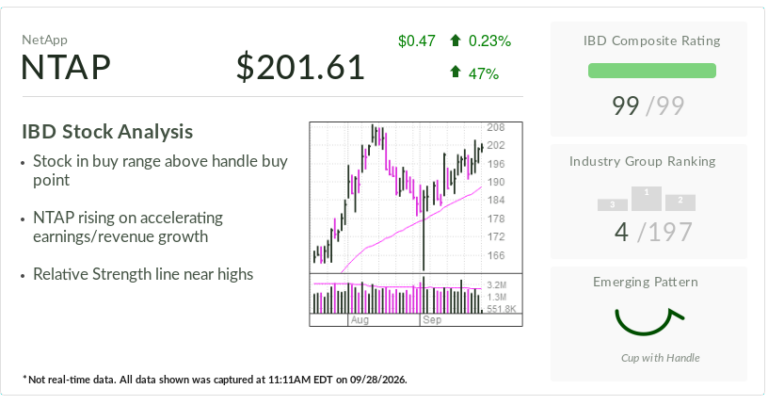
NetApp has found itself firmly in the spotlight as the latest stock of the day for Investor’s Business Daily, riding a wave of momentum fueled by the ongoing artificial intelligence boom. The company has seen its shares rally significantly as investors bet on its ability to provide the critical data storage infrastructure needed to power massive AI workloads. This surge reflects a broader market trend where hardware providers capable of supporting generative AI are seeing rapid valuation growth.

Despite the recent gains, analysts suggest that NetApp is now entering a pivotal phase where it must prove this rally is sustainable. The excitement surrounding AI capabilities often leads to steep climbs in share price, but these peaks frequently face tests when companies report their actual quarterly earnings or updated guidance. Investors are now looking for concrete evidence that AI integration is translating into tangible revenue growth rather than just speculative enthusiasm.

The next few weeks will likely serve as a litmus test for whether NetApp can maintain its upward trajectory or if it will succumb to profit taking. As the market scrutinizes how effectively the firm manages its transition toward more AI centric offerings, technical indicators will be closely watched alongside fundamental performance. Whether NetApp continues its climb depends largely on its ability to meet high expectations in an increasingly competitive enterprise data landscape.

Boeing shares took another hit today after reports surfaced of a new technical issue affecting the landing phase of the 737 MAX. Investors reacted quickly to the news, sending the aerospace giant’s stock sliding as concerns mount over the company’s ability to maintain a clean safety record following years of scrutiny. While the specifics of the glitch are still being analyzed, the timing could not be worse for a manufacturer already struggling to regain full public and regulatory trust.

The latest complication centers on systems that activate during descent and touchdown, raising questions about whether current quality control measures are sufficient. Industry analysts suggest that even minor setbacks at this stage can have outsized impacts on market sentiment, especially when they involve critical flight phases like landings. Airline customers, who rely on predictable delivery schedules and flawless safety profiles, are likely watching these developments with increasing anxiety.

Company representatives have yet to provide a detailed timeline for a fix, though they typically emphasize their commitment to working closely with aviation authorities to resolve such anomalies. However, Wall Street seems less patient than it once was. The dip in share price reflects a growing skepticism among traders who fear that Boeing remains trapped in a cycle of patching old problems while new ones emerge from the assembly line.

As regulators keep a close eye on every move Boeing makes, the pressure is mounting for leadership to prove that systemic changes have actually taken root within the factory walls. For now, shareholders are left bracing for further volatility as the industry waits to see if this landing issue will result in widespread fleet inspections or more restrictive mandates from federal oversight agencies.

The Detroit Lions managed to escape their clash with the New York Jets with a victory, though the win mirrored their opening week struggle by starting strong and ending in a nerve wracking fourth quarter. While the defense struggled to contain explosive passing plays late in the game, they stepped up with a clutch stop when it mattered most to secure the result. Despite the lack of polish, there were clear signs of growth as the offense continued to find its rhythm under Drew Petzing and the front seven successfully stifled the run for much of the afternoon.

Jahmyr Gibbs emerged as the undisputed star of the contest, cementing his status as the engine of Detroit’s attack. In a disciplined performance that favored patience over flashy highlights, Gibbs racked up 164 total yards and three touchdowns, including the decisive score. By recording at least 150 scrimmage yards and three scores for the fourth time since entering the league in 2023, he has joined an elite tier of backs that includes Jonathan Taylor. His ability to move the chains through both rushing and receiving proved insurmountable for a Jets defense that had previously been one of the stingiest in the league.

On the defensive side of the ball, Alim McNeill provided a dominant spark from the interior. Often scrutinized during his recovery and return to form, McNeill acted as a wrecking ball against New York’s offensive line. He tallied seven pressures, tying a personal high not seen since late 2022, and contributed a critical red zone sack that swung momentum back toward Detroit. Meanwhile, stability returned to the offensive line with Blake Miller’s presence at right tackle complementing Penei Sewell’s powerhouse performance on the left side, ensuring Jared Goff remained protected throughout most of his snaps.

However, not everyone saw their value rise following Sunday’s outing. The secondary suffered significant setbacks as cornerbacks D J Reed, Roger McCreary, and Rock Ya Sin struggled to contain Geno Smith’s aerial assault. Together they surrendered 166 yards and two touchdowns without managing a single pass breakup. Their tendency to bite on routes and commit costly penalties nearly gifted the game back to New York, leaving head coach Aaron Glenn with plenty to address before facing Carolina on Sunday night. For now, Detroit survives and advances with more questions answered than solved.

Supreme Court Justice Samuel Alito has officially recused himself from a pivotal climate change lawsuit following mounting pressure regarding his financial ties to the energy sector. While the formal notification submitted to the court offered no specific explanation for his withdrawal, it marks a significant shift for the conservative justice who had previously resisted calls to step away from the proceedings. This move follows a pattern of behavior where Alito has stepped aside from other cases involving corporations in which he maintains personal investments.

The legal battle involves local officials in Boulder, Colorado, who are suing giants like Suncor Energy and ExxonMobil. The plaintiffs allege that these companies intentionally misled the public about the role of fossil fuels in driving global climate change, seeking billions of dollars in damages. The energy firms, supported by the Trump administration, have argued that such lawsuits threaten the entire industry and claim that state courts lack the jurisdiction to handle what they describe as a global environmental crisis.

Although Justice Alito does not hold direct shares in ExxonMobil or Suncor Energy, his financial disclosures reveal holdings in other major oil players including Phillips 66 and ConocoPhillips. Advocacy groups like Consumer Watchdog have argued that any ruling favoring these defendants would create a positive ripple effect across the industry, potentially benefiting Alito’s own portfolio through indirect market gains.

Representatives for Consumer Watchdog praised the decision but suggested it arrived too late. Organizing director Alexandra Nagy noted that under the Supreme Court’s own newly adopted code of ethics, justices are expected to avoid matters where there is a conflict regarding subject matter or controversy. In a statement released following the announcement, Nagy asserted that stepping down was simply the correct decision and expressed her belief that it should have happened when the court first agreed to hear the case back in February.

Supreme Court Justice Samuel Alito has officially recused himself from a pivotal climate change lawsuit following mounting pressure regarding his financial ties to the energy sector. While a formal letter submitted to the court didn’t explicitly detail the reasoning behind his departure, it simply stated that the conservative justice would no longer participate in the proceedings. This move follows a pattern for Alito, who has stepped away from previous cases involving corporations in which he held direct investments.

The legal battle centers on a case brought by local officials in Boulder, Colorado, against industry giants Suncor Energy and ExxonMobil. It is part of a larger wave of litigation alleging that fossil fuel companies intentionally misled the public about the role of their products in driving global climate change. With billions of dollars in potential damages on the line, the stakes are incredibly high for both the municipalities seeking accountability and the energy firms fighting back.

Although Alito does not hold shares specifically in Suncor or ExxonMobil, his financial disclosures reveal holdings in other major players like ConocoPhillips and Phillips 66. Critics, including those from the advocacy group Consumer Watchdog, argued that these investments created a conflict of interest because any ruling favoring the oil industry could indirectly boost Alito’s personal portfolio. They pointed to the Supreme Court’s own recently adopted code of ethics, which suggests justices should avoid matters where they have a specific subject matter interest.

The energy companies involved have long argued that state courts are an inappropriate venue for addressing what they describe as a global environmental crisis and claim these lawsuits threaten the stability of their entire industry. For its part, Consumer Watchdog welcomed the recusal but suggested it was overdue. Organizing director Alexandra Nagy noted that stepping aside was the correct decision and expressed her belief that it should have happened much earlier in the process.

Northern Star Resources has firmly shut the door on an ambitious attempt by South Africa’s Gold Fields to acquire the company in a deal initially valued at over 27 billion US dollars. The Perth-based mining giant, Australia’s largest gold producer, unanimously rejected the unsolicited cash and stock proposal on Monday. While the offer was designed to create a global powerhouse producing millions of ounces of gold annually, Northern Star’s board argued that the bid significantly underestimated the true worth of their portfolio.

Chairman Michael Chaney described the move as highly opportunistic, noting that the proposed price fell far short of the company’s fundamental value. A major point of contention was the timing of the bid, which comes just as Northern Star is preparing for critical growth milestones, such as the ramp up of its Fimiston Mill. Furthermore, the board expressed concerns over the deal structure, which would have left shareholders with a significant equity stake in Gold Fields. Directors felt this shifted too much risk onto investors compared to their current stability within Australian assets.

The failed takeover adds another layer of drama to a turbulent period for Northern Star, which has been under pressure from activist investor Elliott Investment Management. After acquiring a stake in the company and pushing for a strategic overhaul and leadership changes earlier this year, Elliott’s presence likely heightened the scrutiny surrounding any potential merger. Despite Gold Fields claiming that combining operations could unlock billions in synergies and planning a secondary listing on the Australian Securities Exchange to appease local interests, those promises weren’t enough to sway the board.

Market reactions were swift and mixed following the announcement. In Johannesburg, shares of Gold Fields tumbled by 13 percent as investors reacted to the rejection. Meanwhile, Northern Star saw its shares climb more than six percent in Sydney trading, though they still remained below the original implied offer price. While Gold Fields executives say they remain open to constructive dialogue with Northern Star, they have stopped short of confirming whether they will pursue a more aggressive hostile bid to secure some of Australia’s most prized gold assets.