Archive

September 25, 2026

Browsing

Shares of Oracle tumbled seven percent on Thursday after reports emerged that the software giant issued a force majeure notice regarding its ambitious data center development in New Mexico. The move, first reported by Bloomberg and later confirmed by CNBC, appears to be a strategic maneuver to shield the company from escalating costs associated with Project Jupiter. By invoking this legal clause, Oracle is seeking to delay payments to the site developer, a unit of Blue Owl Capital, should the facility fail to go online by its projected 2028 launch date.

Despite the sudden dip in stock price and the legal notification, Oracle has attempted to calm investor nerves. In a statement provided to CNBC, the company insisted that Project Jupiter remains on its planned schedule and reaffirmed its full commitment to the state of New Mexico. Similarly, Blue Owl Capital noted that the notice does not alter the overarching financial obligations tied to the multi year venture, though their own share price felt some pressure during Thursday’s trading session.

The project is far from simple, serving as a critical piece of the larger Stargate artificial intelligence infrastructure initiative linked with President Donald Trump. However, it has been plagued by significant headwinds, including stiff local opposition leading up to midterm elections and mounting scrutiny from environmental advocacy groups. These regulatory hurdles have added layers of complexity to an already high stakes buildout designed to fuel the next generation of AI computing.

Adding to the tension are growing concerns over Oracle’s balance sheet. Reports indicate that roughly eighteen billion dollars in debt tied specifically to these data center expansions are currently trading at stressed levels. While Co CEO Clay Magouyrk previously assured analysts that these developments would not impact revenue or earnings guidance for fiscal 2027, today’s market reaction suggests investors remain wary of the financial risks inherent in such massive infrastructure bets.

Oracle co CEO Mike Sicilia sold roughly 3.4 million dollars worth of company shares this week, a move that coincides with a turbulent anniversary for the software giant. According to regulatory filings, Sicilia unloaded 22,562 shares on September 22 at an average price of 151.59 dollars per share. While the optics may be jarring given the current climate, the transaction was executed under a prearranged trading plan established back in December 2025, suggesting the sale was scheduled long before recent market fluctuations.

The timing of the divestment highlights a stark decline in investor confidence since Sicilia and fellow co CEO Clay Magouyrk took the helm a year ago. When they replaced Safra Catz on September 22, 2025, Oracle stock closed at 328.15 dollars. By late September of this year, the price had plummeted to around 144.44 dollars, marking a staggering loss of approximately 56 percent over their first twelve months in leadership. This downward trend persists even as the company reports strong growth in its cloud infrastructure revenue and massive leaps in total contracted future earnings.

Behind the scenes, Oracle is navigating a brutal internal transition characterized by deep cuts and aggressive pivots toward artificial intelligence. Over the last fiscal year ending in May, the company slashed some 21,000 jobs, which accounts for about 13 percent of its entire workforce. These redundancies hit research and development and sales teams particularly hard, with management explicitly linking these job losses to the integration of AI technologies into their business model. Further rounds of layoffs began again this month as part of what leadership calls broader organizational changes.

Despite these headcount reductions, Oracle is pouring unprecedented amounts of capital into its hardware foundations. Capital expenditures jumped from 8.5 billion dollars a year ago to over 28 billion dollars in the most recent quarter alone, with projections reaching up to 95 billion dollars for fiscal 2027 as data centers are built out to handle AI demands. To fund this expansion, Oracle has turned to significant debt and equity raises totaling billions of dollars. As CFO Hilary Maxson recently noted to staff, the goal isn’t simply for fewer people to do more work but for the organization to be far more selective about where it allocates its resources during this high stakes gamble on AI infrastructure.

Viking Therapeutics has significantly expanded its fundraising efforts, announcing the pricing of two concurrent public offerings totaling roughly 500 million dollars. This move marks a notable increase from the company’s original plans, which initially aimed for smaller targets of 200 million dollars for both common stock and convertible senior notes. By upping these figures, the clinical stage biopharmaceutical firm is positioning itself with a substantial war chest to fuel its ambitious pipeline of treatments for metabolic and endocrine disorders.

The financial structure of the deal includes the sale of nearly 7.9 million shares of common stock priced at 35 dollars per share. Alongside this equity raise, Viking is issuing 225 million dollars in convertible senior notes due in 2032, carrying an annual interest rate of 2 percent. These notes offer investors a path to convert their debt into equity starting in mid 2032, provided certain conditions are met, reflecting confidence in the long term growth potential of the company’s portfolio.

Management intends to funnel the vast majority of these funds into the acceleration of its key drug candidates. Specifically, the proceeds are earmarked for the ongoing clinical development and eventual commercialization of its VK2735 program, as well as further advancement of the VK3019 program. A portion of the capital will also be reserved for general research and development needs and overall working capital to sustain operations during critical trial phases.

A heavy hitting group of financial institutions managed the process, including Morgan Stanley and J.P. Morgan among others who acted as joint book running managers for both portions of the offering. While some options remain for underwriters to purchase additional shares or notes to cover over allotments, the core deals are expected to settle on September 25, pending standard closing conditions. The independence of the two offerings ensures that neither depends on the success of the other to reach completion.

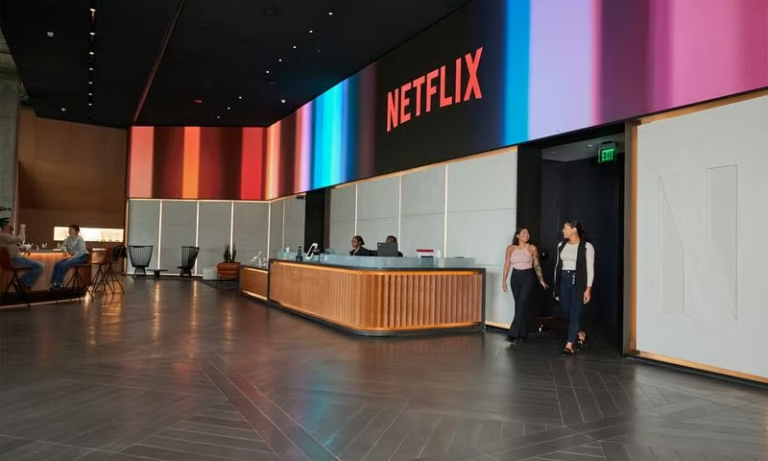
Netflix is facing a bit of a crossroads as its recent financial reports show revenue growth cooling off for two consecutive quarters. After a blistering run throughout 2025 that peaked at seventeen point six percent growth in the final quarter, the momentum has dipped to sixteen point two percent in the first quarter of 2026 and further down to thirteen point four percent in the second. With management forecasting another dip to around twelve percent for the third quarter, some investors are wondering if the streaming giant has hit a ceiling. This trend has weighed heavily on the stock price, which currently sits more than forty percent below its fifty two week high.

Despite these dipping percentages, there is reason to believe this is less about failing demand and more about simple mathematics. Last year was exceptionally strong due to aggressive membership gains and the rapid scaling of an ad supported tier, meaning current results are being compared against very high benchmarks. Looking under the hood, the actual engagement metrics remain robust. Viewers clocked over ninety seven billion hours of content in the first half of the year, and advertising revenue is still on track to nearly double this year to roughly three billion dollars. Furthermore, profit margins continue to expand, suggesting that Netflix is becoming more efficient even as its top line growth stabilizes.

From a valuation standpoint, the stock has become significantly cheaper after its recent slide, trading at roughly nineteen times expected next year earnings compared to multiples in the thirties during its peak. While this makes it far more attractive than it was months ago, it doesn’t necessarily make it an immediate bargain. Current pricing seems to bake in the assumption that growth will level off comfortably around twelve percent rather than continuing to slide into 2027.

Ultimately, while existing shareholders likely have little reason to panic given that profits are still climbing, new buyers might want to exercise patience. A forecast is not a guarantee, and until Netflix delivers a reported quarter where growth actually holds steady rather than slipping further, jumping back in carries some risk. For now, treating the stock as a hold appears prudent until the data confirms that the downward trend has truly bottomed out.

Investors are bracing for a volatile close to the week as several key economic indicators set the stage for Friday’s trading session. Market analysts suggest that the primary focus will remain on incoming inflation data and corporate earnings reports, both of which have triggered erratic swings in tech stocks over the last few days. Traders are particularly keen to see if current trends hold or if a late-week correction is imminent.

Much of the anticipation centers on whether federal policy signals will shift following recent labor market updates. While some optimism remains regarding a soft landing for the economy, any surprise in employment numbers could send ripples through the bond market and force equity investors to recalibrate their portfolios. The tension between cooling prices and resilient consumer spending continues to be the central narrative driving price action across major indices.

Beyond the macroeconomic noise, specific sectors are expected to experience significant movement as high profile companies release their quarterly results before the opening bell. These reports often serve as a litmus test for broader industry health, especially within the artificial intelligence space where valuations have reached historic highs. If these giants miss expectations, it could trigger a wider sell off across mid cap growth stocks.

As the closing bell approaches for the week, sentiment will likely hinge on how well markets digest these conflicting pressures. Most strategists advise caution, noting that while momentum has been strong throughout the month, Fridays often bring profit taking as institutional traders lock in gains ahead of the weekend. For now, all eyes remain glued to the tickers waiting for those first critical data releases of the morning.

Spanish mining developer Abenójar Tungsten is looking toward the London Stock Exchange to secure the funding necessary for its ambitious El Moto project. According to reports from Bloomberg, the company has already brought in heavy hitters like Deutsche Bank, Bank of Montreal, and Peel Hunt to help manage a potential initial public offering. While an official announcement is still pending, industry insiders expect more concrete details to emerge in the next few weeks regarding how the firm plans to raise the 241 million dollars required for the venture.

The timing comes just as the company celebrates a major milestone. After fourteen years of planning and preparation, construction finally began at the El Moto site last week. Founded by the Garcia San Miguel family, the operation is designed as an underground mine focusing on both tungsten and gold. If everything stays on track, commercial production should begin by early 2029, with expectations that the mine will yield over four thousand tons of tungsten concentrate every year for nearly two decades.

Beyond the financial projections, there is a strong geopolitical angle to this move. The European Commission recently labeled El Moto a strategic project under its Critical Raw Materials Act because Europe relies heavily on outside sources for tungsten. Currently, China dominates about 79 percent of global production and strictly controls exports. Because tungsten possesses the highest melting point of any metal, it is indispensable for high tech industries including defense systems, aerospace engineering and renewable energy technology.

CEO Gonzalo Garcia San Miguel described the project as a lifelong mission for his family during a recent inauguration ceremony, emphasizing that the mine serves both local residents and broader European security interests. To address environmental concerns, Abenójar Tungsten says it will utilize dry stacked tailings and reuse mine water to avoid creating surface slurry ponds or discharging waste into the surrounding environment. Financial forecasts suggest these efforts could pay off handsomely, with some models predicting significant annual earnings once the site reaches full capacity.

The global economy managed to survive the largest energy supply disruption in modern history this year, but experts warn that the safety nets used to prevent a total collapse are nearly exhausted. A new report from McKinsey and Company reveals that while the world avoided a 1970s-style recession despite severe closures in the Strait of Hormuz, the mechanisms that shielded markets have worn thin. At its worst, the disruptions impacted fourteen percent of the combined global oil and gas supply, a blow far more significant than the 1973 Arab oil embargo or the initial shocks following Russia’s invasion of Ukraine.

This surprising resilience was made possible by a frantic rewiring of global trade and a heavy reliance on emergency reserves. To fill an immediate gap of fifteen million barrels per day, nations tapped into their strategic stockpiles, with the United States leading a coordinated effort via the International Energy Agency. Simultaneously, pipelines in Saudi Arabia and the UAE ran at maximum capacity to divert flow away from contested waters. In China, refiners pivoted toward domestic coal-to-chemical conversions and American ethane to maintain production. However, these were temporary fixes rather than sustainable solutions.

Now, those buffers are dangerously low. The U.S. Strategic Petroleum Reserve has dropped below three hundred million barrels, nearing its legal floor, while overall global inventories have been depleted by half a billion barrels since the start of the crisis. Further complicating matters is a decline in refining capacity across the Gulf region and Russia, leaving critical fuels like diesel and jet fuel at five year lows across Europe and North America. Essentially, the world spent its insurance policy to get through this cycle and now finds itself vulnerable to any subsequent shock.

To combat this fragility, governments are rushing to build new bypass pipelines and diversify their sources of energy. While some hope that shifting toward green technology will solve the problem, McKinsey suggests there is a technical ceiling to how much fossil fuel can actually be replaced given current limitations in aviation and heavy shipping. For now, policymakers face an expensive balancing act: investing billions in redundant infrastructure and diversions just to ensure that the next major supply chain break does not trigger a systemic economic failure.

FIRST ON FOX: The Vance-led anti-fraud task force and the General Services Administration uncovered more than $1.2 billion in suspected COVID-era contract fraud as the White House anti-fraud task force continues its crackdown across the country.

The General Services Administration, along with the Department of Health and Human Services, found that COVID emergency contracting continued after the pandemic emergency officially ended. The agencies also revealed that millions of vaccine contracts were awarded even after the pandemic ended under the Biden administration.

“The COVID emergency ended over three years ago, yet fraudsters continue to weaponize outdated emergency contracts to abuse taxpayer dollars,” GSA Administrator Edward C. Forst told Fox News Digital in a statement. “Thanks to the leadership of President Trump and Vice President Vance’s Task Force to Eliminate Fraud, GSA uncovered $1.22 billion in suspected fraud across five HHS COVID-era contracts.”

AG BLANCHE UNVEILS FEDERAL CHARGES AGAINST 160 DEFENDANTS IN PANDEMIC RELIEF SWEEP

“GSA will continue to work with the Vice President’s task force to stop improper payments, refer suspected fraud to law enforcement, and fight to recover every dollar,” he added.

While the funding uncovered is not currently tied to criminal charges for contractors, the agencies have pinpointed a significant amount of taxpayer dollars that may have otherwise been distributed for COVID vaccines and other pandemic-related services long after the national emergency ended.

GSA estimates that an estimated 93% of the funding for the contracts has not yet been distributed to vendors, while roughly 6.78% has already been expended. The agency has since suspended payments to contractors as part of the initiative.

“The COVID emergency ended in 2023. The emergency contract advantage didn’t — until now.”

WHITE HOUSE PUSHES ‘WATERSHED’ FRAUD-FIGHTING REFORM IN CONGRESS AS VANCE CONVENES TASK FORCE

White House Task Force to Eliminate Fraud Executive Director Scott Brady told Fox News Digital in a statement. “GSA’s review uncovered $1.22 billion in suspected fraud and stopped $41 million more across five HHS COVID-era contracts that kept the emergency label alive long after the emergency was gone.”

Brady said that allocated emergency funding “is a privilege, not a blank check,” while describing contractors who received funding to combat the pandemic at the time as “honest.” He characterized any funding that was distributed beyond the emergency as a “free pass.”

WHITE HOUSE LAUNCHES INTERACTIVE MAP TRACKING BILLIONS IN SUSPECTED FRAUD

The announcement comes after the General Services Administration found more than $13 billion in suspected contractor fraud in late August, and the Trump administration has declared a total of more than $245.7 billion has been uncovered since the president took office and that it has prevented an annualized $62.9 billion in fraudulent payments.

The White House anti-fraud task force also says that more than $59.1 billion in indictments and settlements are being enforced.

WHITE HOUSE TO YANK 750,000 FRAUDSTERS OFF OBAMACARE, SAVE TAXPAYERS $2.2 BILLION, VANCE SAYS

The Department of Health and Human Services, which oversees Medicare and Medicaid, has uncovered the most significant amount of fraud at $96.4 billion.

As for the beneficiaries of fraudulent activity, the Trump administration has identified some foreign nationals who have infiltrated the federal contracting system and acquired funds while still residing in their home countries.

EXCLUSIVE: FBI’S FIFTH MOST WANTED FRAUDSTER CAPTURED AFTER ALLEGED SNAP SCAM SUSPECT ARRESTED IN INDIA

Earlier this month the FBI released a “Most Wanted” list highlighting alleged fraud suspects as the administration continues its broader crackdown on fraud. Officials say the involvement of foreign nationals in multiple schemes has heightened concerns about overseas actors exploiting U.S. government programs.

Among those named is Onur Simsek, a Turkish national whom the FBI believes is living in Turkey. Prosecutors accuse Simsek of leading a defense procurement fraud scheme that secured U.S. military contracts by falsely certifying Turkish-made parts as tested and qualified, potentially rendering critical military equipment inoperable.

FRAUD EXPERT EXPOSES HOW HIDDEN NETWORKS DROVE MINNESOTA FRAUD, OTHER MAJOR SCAMS: ‘CRIMINAL ENTERPRISE’

Federal authorities allege Simsek is one of a number of foreign nationals who have infiltrated and exploited U.S. federal funds to obtain taxpayer funds.

In an interview with Fox News Digital last month, Vice President JD Vance said authorities have observed what he described as a “clear pattern” in some fraud cases involving immigrant communities.

“You definitely see patterns in certain communities,” Vance said. “It’ll start as maybe one Somali person takes advantage of the system, or realizes you don’t even have to have children to get money from these programs. You could just claim that you have children, there’s no verification. Then, word spreads like wildfire, and that program gets tapped into by the same members of that community.”

Despite voter fury and rising fuel prices, most Republican senators stayed the course with President Donald Trump and his war on Iran in a vote Thursday.

Though vulnerable Republicans on the campaign trail broke with Trump earlier this week, calling for an “immediate end” to the war, lawmakers on the Hill stuck with him and defeated another attempt by Democrats to rein in his war authorities as the conflict nears the eight-month mark.

Still, there was a group of rebellious Republicans who had consistently voted with Democrats, including Sens. Susan Collins, R-Maine, Lisa Murkowski, R-Alaska, Rand Paul, R-Ky. New blood was added this time with Sen. Thom Tillis, R-N.C.

REPUBLICANS BREAK WITH TRUMP TO REBUKE IRAN WAR — BUT IT WON’T CHANGE POLICY

Tillis, who is retiring at the end of the year, argued his decision to vote for the latest war powers resolution came after the administration again blew past a 60-day deadline to involve Congress.

“We know the resolution’s not gonna pass, but it is important to start saying, ‘We deserve an update. You better start treating — Congress can be an assistance with this war effort, if you inform us,’” Tillis said.

To Tillis’ point, the resolution that failed in the Senate, which passed in the House with seven Republican defectors, would have headed to the president’s desk, where it likely would have been vetoed. And without a veto-proof majority, the effort wouldn’t have teeth legally. However, it will hurt on the airwaves in the ads to come.

GOP CRACKS WIDEN OVER IRAN WAR AS VULNERABLE CANDIDATES BREAK WITH TRUMP, DEMAND ITS END

Thursday’s vote comes as Republicans are getting an earful about the war, particularly over skyrocketing gas and diesel prices, on the campaign trail. Senate Majority Leader John Thune, R-S.D., acknowledged that fuel prices are a growing issue for Americans.

“Well, I think people are, there’s voter fatigue with high gas prices and high diesel prices in my part of the world,” Thune said.

“So, that’s a frustration, it’s an economic frustration, and that’s why, again, I hope the administration is laser-focused on trying to get the [Strait of Hormuz] open, get the shipping lights opened up, and help out with that global energy supply, because that ultimately will get prices down,” he continued.

Three vulnerable Republicans running for toss-up seats this week, Rep. Ashley Hinson, R-Iowa, former Rep. Mike Rogers in Michigan, and Sen. Jon Husted, R-Ohio, all requested that the fighting come to an “immediate end” as the war grows in unpopularity with their voters.

TRUMP DEFENDS US INTERVENTIONS ABROAD AHEAD OF ‘BIG DECISION’ ON IRAN: ‘SETTLING YEARS OF UNFINISHED BUSINESS’

Sen. Tim Kaine, D-Va., who has acted as the self-anointed traffic cop for the deluge of Democratic war powers resolutions over the last several months, diagnosed the defections as a by-product of reports that U.S. bombs had fallen on an Iranian school and that diesel costs are “going up and up and up.”

“They are listening to their constituents. They should [have] listened to them before now, because their constituents were saying, ‘Don’t get into this thing,’” Kaine said. “But they’re finally listening to them. And nothing makes you listen as much as an election staring you in the face.”

But Trump isn’t swayed by the effects that the conflict could have on the midterm elections as the GOP fights to keep power in Congress.

“The Republican Party is running, and I’ll be helping them, but I am not running,” Trump told reporters this week. “I gave absolutely no credence and will not give credence to the election when it comes to Iran. It doesn’t even enter my mind. The only thing that does is that Iran will never have a nuclear weapon.”

This post appeared first on https://www.foxnews.com

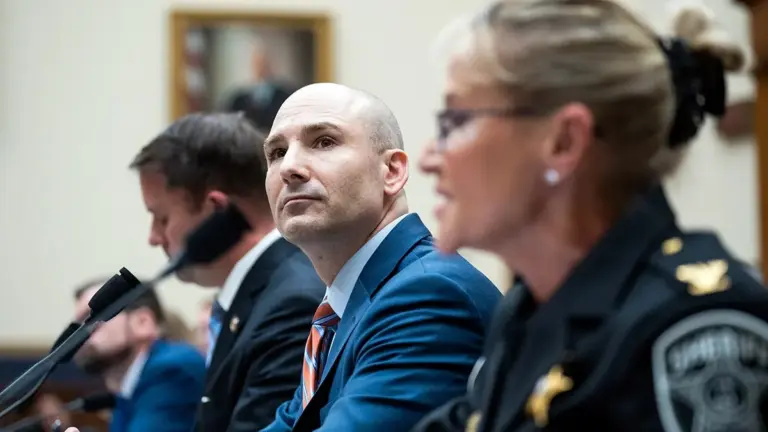
Fairfax County Commonwealth’s Attorney Stephen Descano is facing a forceful rebuke from a former federal prosecutor who extensively criticized his record after announcing her bid to unseat him.

Descano, a Democrat, has faced criticism over what opponents describe as lenient prosecutorial decisions, particularly in serious cases involving illegal immigrant suspects. Former federal prosecutor Brittany Dunn-Pirio said that if there weren’t systemic problems in his office, she would want to work there.

“If this office were doing its job, I wouldn’t be running against it. I’d be applying to work for it. But it isn’t,” Dunn-Pirio said on her new campaign website after Washington, D.C.-area media reported her bid late Wednesday.

VIRGINIA DEMS SPLIT ON DOJ PROBE OF SOROS-BACKED DA ACCUSED OF GIVING ‘SWEETHEART DEALS’ TO ILLEGAL ALIENS

“I’m a Democrat. This race isn’t about whether reform was right. It’s about whether the office can tell the difference between a first-time nonviolent offender who deserves a second chance and a violent or sexual offender who doesn’t,” Dunn-Pirio said on her website.

“It’s about whether deadlines are met, evidence is given to the defendant and victims are spoken to.”

VIRGINIA DEM DEFENDS SOROS-BACKED PROSECUTOR FROM DOJ PROBE AFTER ILLEGAL IMMIGRANT CHARGING ALLEGATIONS

Fox News Digital reached out to Descano and Dunn-Pirio for further comment.

Descano campaign spokesman Nathan Kiker defended the incumbent’s record, telling Fox News Digital that “Steve Descano has spent his tenure proving that you can reform the justice system and keep our community safe at the same time.”

“Today, Fairfax County is recognized as the safest large county in the nation because Steve focused on accountability and the root causes of crime rather than failed policies of the past. We are proud to put that record before the voters,” Kiker said.

Dunn-Pirio also pointed to “botched sexual assault cases” and prosecutors declining to meet with victims, along with her contention that the justice system too often favors the “well-connected.”

One case that has drawn the scrutiny of Descano’s office involves Abdul Jalloh, an illegal immigrant from Sierra Leone charged with murdering Stephanie Minter. Minter was stabbed and killed at a Hybla Valley bus stop in February after Jalloh had cycled through the criminal justice system following numerous previous arrests.

Descano has pushed back on claims that his office simply allowed Jalloh to walk free, telling Congress his prosecutors obtained convictions against him “wherever possible.”

SOROS-BACKED DA’S LAX ILLEGAL IMMIGRATION POLICIES LED TO ‘PREVENTABLE’ BUS STOP STABBING MURDER: COMPLAINT

Dunn-Pirio previously served as a prosecutor in Frederick County, Virginia, and as a federal prosecutor in the district covering Lexington, Kentucky. She said she resigned from the DOJ in 2025 after working on COVID-related fraud and similar cases.

“I couldn’t stomach propping up a system that gave pardons to the well-connected while prosecuting average Americans for the same conduct,” she said, according to a release obtained by FairfaxNow.

She also said Descano’s office has spent too much time “failing the people I care about.”

A carousel on her new campaign website highlights cases that have drawn public scrutiny of Descano, including:

REPEAT OFFENDER WITH DOZENS OF PRIOR CHARGES ARRESTED FOR BURGLARIZING CHURCH IN SOROS-BACKED DA’S COUNTY

“We need a Commonwealth’s Attorney who can make this office work,” Dunn-Pirio said. “Every person in Fairfax should feel safe, and every person in Fairfax should be able to trust the office that’s supposed to protect them.”

Descano’s campaign did not immediately respond to an additional request for comment on Dunn-Pirio’s criticism.

Dunn-Pirio, most recently an associate at the civil litigation firm Harman, Claytor, Corrigan & Wellman, served as an assistant U.S. attorney in Kentucky for two years before resigning in November 2025. At the Justice Department, she specialized in COVID relief fraud and public corruption cases, according to her LinkedIn profile.

“Most recently I was a federal prosecutor, and I resigned from the Justice Department because I couldn’t stomach propping up a system that gave pardons to the well-connected while prosecuting average Americans for the same conduct,” Dunn-Pirio said.

Before becoming a federal prosecutor in 2023, Dunn-Pirio served as an assistant commonwealth’s attorney in Frederick County, an assistant attorney general in the state criminal appeals courts and a law clerk to Judge Randy Bellows in Fairfax County Circuit Court.

Dunn-Pirio emphasized that she is a “cradle Democrat,” distinguishing her candidacy from a challenge to Descano from the political right.

SIGN UP TO GET THE POLITICS NEWSLETTER