

Archive

September 26, 2026

Browsing

Shares of Micron Technology have entered a period of uncertainty as investors brace for the company’s upcoming fiscal fourth quarter earnings report. The stock has shown signs of wavering recently, reflecting a broader tension in the market between optimism over artificial intelligence demand and caution regarding the cyclical nature of memory chip pricing. Traders are currently weighing whether the surge in high bandwidth memory needs will be enough to offset potential headwinds in other sectors.

Analysts are keeping a close eye on how Micron manages its guidance for the next year, particularly as competition intensifies among semiconductor giants. While the AI boom has provided a significant tailwind for companies specializing in storage and processing power, any sign of slowing growth or inventory buildup could trigger further volatility. This hesitation suggests that shareholders are seeking concrete evidence that current valuation levels are sustainable before committing to new positions.

The anticipation surrounding these results comes at a critical time for the industry, where geopolitical tensions and supply chain shifts continue to play a role in long term strategy. As Micron prepares to unveil its latest financial figures, the focus remains squarely on profit margins and revenue forecasts. Until those numbers hit the wire, it seems likely that the stock will continue to drift sideways as the market waits for clarity on the company’s trajectory heading into 2025.
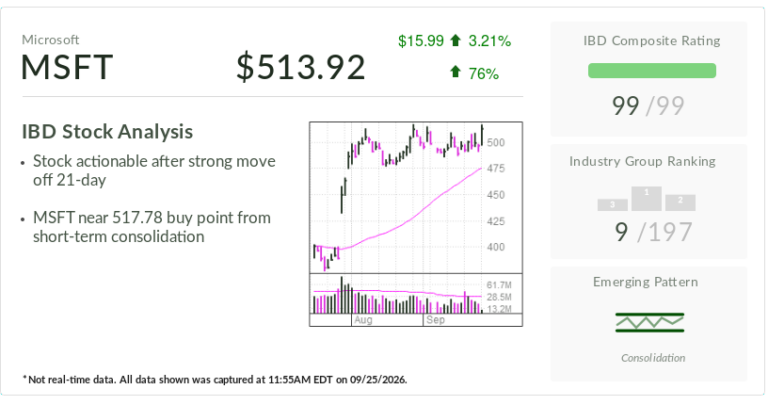

Microsoft has captured the attention of Wall Street this week after being named the stock of the day by Investor’s Business Daily. The software giant saw its shares make a decisive bullish move following the announcement of a new AI super app designed to integrate various productivity tools into one seamless experience. Analysts suggest that this latest push into artificial intelligence is intended to solidify Microsoft’s dominance in the enterprise sector while providing users with a more centralized hub for automated workflows.

The market reaction reflects growing confidence in how Microsoft is monetizing its massive investments in generative AI. By bundling complex capabilities into a single application, the company aims to reduce friction for corporate clients and increase user retention across its ecosystem. This strategic shift comes at a time when competitors are scrambling to launch similar integrated platforms, making Microsoft’s first mover advantage particularly valuable to shareholders.

While the immediate price action indicates strong optimism, investors remain focused on whether these technological advancements will translate into long term revenue growth. The momentum behind the current rally suggests that traders view the super app as more than just a feature update, seeing it instead as a fundamental evolution of how people interact with software. As the rollout continues, all eyes will be on adoption rates and quarterly earnings to see if the hype matches the actual utility delivered to consumers.

Investors are being warned that the current turbulence in the bond market is far from over, according to a sobering outlook from BNP Paribas. In a recent client note, the bank suggested that yields on 30 year Treasury bonds could climb as high as 5.6 percent in the coming months, continuing a steady upward trajectory since the start of the year. Because rising yields translate directly into falling bond values, this trend creates a challenging environment for stockholders who often pivot away from equities when they can secure safer, risk free returns from government debt.

A primary driver behind this instability is the Federal Reserve’s anticipated rate hike cycle. Analysts warn that further increases through 2026 and early 2027 will substantially inflate the cost of borrowing for the U.S. government. Guneet Dhingra, BNP’s head of US rates strategy, noted that these hikes could add upwards of 168 billion dollars in interest expenses by the second year alone. To put that figure into perspective, such an increase would effectively wipe out all incremental tariff revenues collected in 2025, leaving the Treasury in a tighter financial squeeze.

Compounding these interest costs is a widening federal budget deficit fueled by tariff rollbacks and refunds. Experts describe this as a dangerous feedback loop where rising rates lead to higher deficits, which then push rates even higher. There is also growing concern regarding government spending habits following the upcoming midterm elections. While some believe a divided government might curb expenditures, history suggests otherwise; similar political splits in the past did little to slow spending streaks.

Adding fuel to the fire is a bipartisan commitment to increased military funding, with a massive 250 billion dollar bump to the defense budget already approved by the Senate Armed Services Committee. Between soaring energy prices driving inflation and heavy borrowing demands from artificial intelligence developers, analysts argue there are few forces left to stop yields from climbing_further_. For now, those managing portfolios should prepare for a period of sustained volatility as fiscal risks mount across Washington.

The landscape of private technology valuations has entered uncharted territory, with giants like OpenAI and Anthropic pushing toward trillion dollar marks long before they ever hit a public stock exchange. While these staggering numbers make for impressive headlines, they create a complex financial reality for the employees holding stock options. Recent research from Equitybee suggests that while the potential for wealth is higher than ever, particularly in the AI sector where new hire grants are roughly twenty seven percent larger than in other industries, the cost of actually owning those shares is climbing just as fast.

For many workers, these record valuations turn equity into a double edged sword. Because most options require employees to pay a strike price to exercise their shares, a skyrocketing company valuation means that new hires face significantly higher entry costs. Data shows that over half of recent grants required at least fifty thousand dollars to exercise fully before taxes, with nearly one fifth requiring upwards of two hundred and fifty thousand dollars. This creates a barrier where the very success of a company makes it more expensive for its newest team members to secure their piece of the pie.

This financial tension becomes even more acute when employees leave a company. Most firms give departing staff a narrow window, often around ninety days, to buy their vested options or lose them entirely. In an era where companies stay private longer—with the median age at IPO now reaching twelve years—employees may find themselves forced to sink their life savings into illiquid shares during a career transition, all while facing potential tax bills before they can even sell the stock. Unlike investors who hold preferred shares, employees deal with common stock and internal appraisals that don’t always mirror the flashy headline valuations seen in funding rounds.

To mitigate this risk, some late stage private companies are increasingly turning to tender offers, allowing employees to sell portions of their holdings back to investors without waiting for an IPO. Activity in this area is rising steadily as firms recognize that liquid gold is more attractive than theoretical wealth tied up in a private ledger. Ultimately, as tech valuations continue to break records, experts suggest that candidates should treat equity less like a lottery ticket and more like a detailed contract negotiation, scrutinizing everything from strike prices to liquidity windows before signing on the dotted line.

Micron Technology has already given investors the kind of returns usually reserved for fairy tales, soaring over five hundred percent in just a single year. Now that shares are trading around the thousand dollar mark, speculators are asking if the stock could climb all the way to two thousand dollars. While such a jump would push the company’s market capitalization past two trillion dollars, reaching that milestone might not require a miracle of valuation but rather a fundamental shift in how the memory industry operates.

The primary reason to believe in this moonshot is the possibility that Micron is entering an entirely new era. Recent financial reports show explosive growth, with revenue leaping from under ten billion to over forty billion dollars in a year. This surge is driven by the insatiable appetite of artificial intelligence systems for memory. More importantly, Micron is securing multi-year strategic agreements worth billions, which suggests that the old days of wild volatility might be ending. If these contracts make revenue and pricing predictable, Micron ceases to be a volatile cyclical play and becomes a stable powerhouse. Based on current projections, achieving a two thousand dollar share price would only require sustained earnings that aren’t far off from where they stand today.

However, there is a significant reason to remain cautious: today’s profit margins may be an unsustainable peak. A gross margin of eighty-four percent is nearly unheard of in this sector and typically acts as a signal for competitors to flood the market. Rivals like China’s CXMT are already gaining ground and capturing more global revenue. History shows that whenever memory profits spike, manufacturers ramp up production until supply outweighs demand and prices crash. If this pattern repeats, today’s windfall could be a temporary anomaly rather than a new baseline.

Ultimately, the path to two thousand dollars depends on whether Micron can make these extraordinary earnings look normal over several years. Investors must decide if AI has truly broken the traditional cycle of boom and bust or if we are simply witnessing another bubble before an inevitable correction. For those holding onto their shares, the most critical metric to track moving forward will not be total sales, but whether those massive profit margins hold steady against rising competition.

Michael Burry, the investor famous for predicting the 2008 financial crisis during The Big Short, is steering clear of the artificial intelligence frenzy currently gripping Wall Street. While many traders continue to chase the high of tech stocks, Burry describes the atmosphere as a crowded house party filled with blind optimism. In a recent update shared via Substack, he admitted to ignoring the excitement, comparing the current obsession with AI infrastructure to the dangerous bubbles of the dot-com era and the mid-2000s housing crash.

Instead of betting against technology companies directly, Burry is playing a subtler game by investing in the raw materials that power them. His most significant new move is a bet on Ero Copper, a Brazilian mining firm. Burry argues that while everyone else is focused on software and chips, they are forgetting that these systems require massive amounts of physical wiring. He believes we are heading toward a severe structural deficit in copper because major new discoveries have dried up since the nineties, and it takes nearly two decades to bring a new mine into production.

Beyond metals, Burry is diversifying his portfolio with several unconventional plays across various sectors. This includes taking a position in QXO, a building products distributor led by experienced entrepreneur Brad Jacobs. He is also hunting for value in deeply discounted stocks that have been battered by the market over the last year, adding names like Australian furniture retailer Temple and Webster, Sprouts Farmers Market, and animal health giant Zoetis to his holdings.

By shifting his focus away from Silicon Valley and toward commodities and undervalued retail assets, Burry is once again positioning himself against the prevailing crowd. To him, the warnings signs are flashing red just as they did in 2007 when officials insisted there was no housing bubble. Rather than joining the celebration inside the house party, he seems content to wait on the sidelines where he believes true value actually resides.

Canadian explorer Grafton Resources has significantly expanded its footprint in South America after securing an exclusive option to acquire two promising gold projects in Chile from mining giant Newmont. Under the terms of the agreement reached on September 21, Grafton earns the right to take full ownership of the Poseidon and Jabali properties. This move is more than just a simple land grab; it allows Grafton to merge the Poseidon project with its current Alicahue asset, creating a massive, contiguous exploration block spanning over 14,000 hectares in the heart of the Andean mineral belt.

The strategic value of the Poseidon site is backed by impressive preliminary data left behind by Newmont. Previous surface sampling revealed high grade results, including some rock chips containing up to 234 grams per ton of gold and 1,500 grams per ton of silver. Geological reports suggest that these minerals are linked to a regional fault zone with a potential strike length of 15 kilometers, pointing toward wide spread deposits of gold, silver, and copper throughout the newly unified district. Meanwhile, the Jabali project offers a different kind of opportunity as a completely undrilled site that already has the necessary infrastructure in place for immediate testing.

Campbell Smyth, Chairman and CEO of Grafton Resources, expressed strong optimism regarding the deal, describing it as a pivotal moment for the company. He noted that while Poseidon and Alicahue form an exciting epithermal vein cluster, Jabali provides a fresh chance to test for high sulfidation mineralization. With both assets now within reach, Smyth indicated that his team intends to launch work programs rapidly to determine exactly how much gold lies beneath the Chilean soil.

For Newmont, headquartered in Denver, this divestment is part of a broader effort to streamline its global operations and restructure its corporate portfolio. The company has recently been navigating complex industry relationships, including a nearly two billion dollar settlement with Barrick Gold earlier this year. Despite trimming some of its peripheral holdings, Newmont remains a financial powerhouse, reporting billions in free cash flow and adjusted net income during its second quarter along with significant gold production totals.

Medical researchers at the Mayo Clinic have developed a groundbreaking artificial intelligence model capable of predicting pancreatic cancer risks several years before a formal diagnosis occurs. This innovative tool aims to solve one of the most devastating challenges in oncology, as pancreatic cancer is notoriously difficult to detect early despite having a slow development period of five to seven years. Because symptoms typically do not emerge until the disease has progressed beyond the point of cure, fewer than twenty percent of patients are currently diagnosed in time for successful treatment.

The AI was trained using a massive dataset consisting of electronic health records and routine laboratory tests from over 39,000 individuals, some with nearly two decades of medical history. By analyzing these common data points, the model demonstrated a high level of accuracy in identifying high risk patients up to three years before their diagnosis. Specifically, researchers found that when the model predicted a risk higher than fifty percent, there was an eighty eight percent likelihood that the patient would be diagnosed with the disease within a single year.

One of the most promising aspects of this technology is its potential for global scalability. Since the model relies on standard health records and lab results used in hospitals worldwide, it could theoretically be integrated into diverse healthcare settings without requiring specialized equipment. Dr. Cornelius Thiels and his team are currently moving the tool from retrospective research into prospective clinical environments to further validate its effectiveness in real world scenarios.

This breakthrough follows other recent advancements at Mayo Clinic, including another AI tool called REDMOD that identifies hidden tumors on ordinary CT scans far more effectively than human specialists. As healthcare enters what experts call a prime time for innovation, these tools represent a shift toward personalized medicine and ultra early diagnostics. For physicians and patients alike, the ability to spot such a lethal disease while it is still treatable could fundamentally change survival rates from mere months to many years.

On paper, gold miners are currently presenting one of the most compelling cases in the equity market, boasting wide profit margins and some of the lowest valuations seen in decades. Despite these fundamentals, a strange disconnect persists as generalist investors remain firmly on the sidelines. While the S&P 500 trades near historic highs, mining companies are generating strong cash flows and paying dividends while occupying a mere two percent of global equity markets. This represents the smallest share for the sector in fifty five years, creating a stark contrast between a bloated broader market and an undervalued mining industry.

Industry experts suggest that history often repeats itself in these cycles. Typically, specialist investors enter first, followed by a wave of generalist capital from retail traders and pension funds that triggers the largest rallies. This pattern played out during the booms of the late seventies and again in the early twenty tens. According to Jeff Clark of the Paydirt Prospector, who spoke at the September Metals Investor Forum in Vancouver, the current gap is unsustainable. He notes that free cash flow per share among miners has surged tenfold since 2020, yet many main street investors have ignored this growth in favor of high priced tech stocks.

The vulnerability of the wider market may eventually serve as the catalyst for this rotation. To put things in perspective, Clark pointed out that the top fifty gold miners combined possess a smaller total valuation than Nvidia alone. With over half of S&P companies trading at multiples far exceeding long term averages, there is a growing sense that a correction in traditional equities could drive cautious money toward gold stocks. If generalist investors begin to crowd into such a small corner of the market, it could spark significant upward pressure on stock prices due to sheer demand.

Underpinning this entire setup is steady institutional support from central banks worldwide. Driven by geopolitical uncertainty and a desire to reduce reliance on the US dollar, nations like China have aggressively increased their gold reserves over several consecutive years. While this sustained demand has pushed physical gold prices higher, mining equities have failed to keep pace, leaving them fundamentally disconnected from the metal they produce. For those watching the charts, it appears that once generalist money makes its move, it will likely target large producers with established cash flows and diversified ETFs before trickling down further into the sector.

It was a volatile week for Canadian equity markets, characterized by mixed results across the major indices and a heavy focus on macroeconomic pressures. While the S&P/TSX Composite Index managed a slight gain of 0.35 percent, both the TSX Venture and CSE Composite Indices saw declines near two percent. Investors spent much of the week digesting fresh inflation data from Statistics Canada, which showed an annualized climb of 3 percent driven largely by soaring gasoline prices amid geopolitical tensions in the Persian Gulf.

Despite these headwinds, the federal government attempted to stimulate growth through its inaugural Canadian Investment Summit. The event aimed to attract one trillion dollars in funding over the next decade for key economic sectors, including resources. Early reports suggest the goal is already halfway met, with substantial commitments coming from major financial institutions like TD Bank and Scotiabank, as well as partnerships involving Brookfield Asset Management and the Canada Pension Plan Investment Board. To further sweeten the deal for investors, Ottawa introduced a productivity mega deduction that significantly lowers the effective marginal tax rate for companies investing in new assets.

In the commodities space, precious metals provided some optimism as gold closed up more than one percent and silver surged over four percent for the week. Copper also trended upward, gaining about 2.57 percent on the Comex. These favorable metal prices helped propel several junior miners to impressive gains despite the broader market instability seen in venture exchanges.

Leading the charge among mining stocks was Orosur Mining, which saw its share price skyrocket by 63.27 percent this week. The Colombian-focused explorer captured investor attention after releasing positive updates regarding its flagship Anza project. Specifically, new assay results from its El Cedro target revealed a fully mineralized interval averaging nearly one gram per tonne of gold over sixty-one meters, fueling confidence in Orosur’s ability to expand its footprint in South America’s primary gold belt.