
Archive

October 22, 2026

Browsing

Investors reacted with enthusiasm on Wednesday as SpaceX revealed a massive surge in revenue and hinted at a historic corporate realignment. The company reported third-quarter revenue of 14.6 billion dollars, representing a staggering 161 percent increase over the previous year and easily clearing analyst expectations. This financial turnaround was highlighted by a net income of 4.4 billion dollars, a sharp reversal from the losses seen during the same period last year. Much of this success is being attributed to the steady stream of recurring revenue from Starlink and the explosive growth of the company’s new artificial intelligence venture, which it has rebranded as Super Intelligence.

Adding fuel to the rally, Elon Musk suggested during an earnings call that he is exploring a potential merger between SpaceX and Tesla. Such a move would likely stand as the largest corporate consolidation in history. Musk noted that both companies have already established special committees to investigate the merits of joining forces, arguing that cooperation is essential as society approaches what he described as the superintelligence singularity. While investors processed this revelation, similar excitement spilled over into the broader aerospace sector, lifting shares for firms like Rocket Lab and AST SpaceMobile.

Looking ahead, SpaceX provided an optimistic outlook that far exceeded Wall Street’s predictions, forecasting first-quarter 2027 revenues between 33 billion and 37 billion dollars. Chief Financial Officer Bret Johnsen credited these projections to a clear inflection point in their high-tech infrastructure and insatiable demand for AI cloud services. Analysts suggest that SpaceX’s ability to maintain pricing power despite economic headwinds provides a strong bullish signal for other cloud providers in the industry who are fighting to capture similar market share.


Investors are sounding the alarm on Netflix after a disappointing third quarter left the streaming giant grappling with slowing growth and a sliding stock price. Shares tumbled more than six percent in early trading, hitting a new 52 week low of 64.35 dollars as Wall Street questioned whether the platform can maintain its dominance in an increasingly crowded market. While membership numbers remain relatively stable, the mood among analysts has shifted toward caution following several quarters of light guidance and missed expectations.

The internal turmoil is becoming visible through a wave of executive shakeups, including significant layoffs and the appointment of Peter Rice as chief content officer. Co CEO Ted Sarandos admitted during an earnings call that while the overall corporate strategy remains unchanged, execution in the United States has fallen short. Sarandos noted that while the company has seen steady success with smaller wins, it desperately needs more home run titles that can translate into global phenomena to drive meaningful expansion.

Wall Street experts are divided on how quickly Netflix can pivot. Some analysts point to stiff competition from TikTok and YouTube as structural threats that are eating away at viewer attention spans. Others highlight a lack of massive global hits recently, suggesting that the current content engine is stalling. This perceived drought has led firms like Evercore ISI to slash their price targets, questioning if there is a viable fix for the plateauing revenue growth.

Despite the pessimism, some observers believe the worst is yet to come and see potential in New ventures. Proponents of the long term bull case argue that expanding ad supported plans into fifteen new markets by 2027 and leaning further into live events like NFL games could reignite user engagement. For now, however, the pressure rests squarely on new leadership to deliver a blockbuster slate that proves Netflix can still capture the cultural zeitgeist.

Meta surged ahead in the third quarter, reporting revenue of 64.60 billion dollars, comfortably beating analyst expectations and marking a twenty six percent increase from a year ago. This financial momentum appears largely tied to the company’s aggressive pivot toward artificial intelligence. CEO Mark Zuckerberg highlighted the successful launch of Muse and Muse Wonder, noting that their AI personal assistants have already seen rapid adoption. According to Zuckerberg, shopping has emerged as the most popular use case for these tools, with millions of users in North America utilizing the technology for high value purchases.

However, the road to an AI future remains expensive. While the core advertising business thrives, Meta’s Reality Labs continues to bleed cash, posting a staggering four point thirteen billion dollar loss this quarter against just under four hundred and fifty million dollars in sales. To support this transition, Meta is narrowing its focus on massive infrastructure investments, projecting annual capital expenditures between 135 billion and 145 billion dollars to build out the data centers necessary to power its next generation of models.

Internally, the company is still feeling the effects of recent restructuring efforts. Chief Financial Officer Susan Li confirmed that Meta’s workforce shrank by twelve percent this quarter down to sixty six thousand employees following broad layoffs over the summer. Beyond staffing changes, investors are eyeing a planned introduction of non voting Class C common stock coming in early 2027, a move designed to fund growth while maintaining Zuckerberg’s control over the firm’s strategic direction.

Adding a layer of personal drama to the corporate update, Meta disclosed that Mark Zuckerberg may relocate his primary residence away from California. The potential move stems from concerns over Proposition 40, a proposed wealth tax that could leave him liable for billions of dollars based on his stock holdings. As the social media giant navigates these regulatory hurdles and hardware setbacks, its overall trajectory remains buoyed by an appetite for AI integration across Facebook and Instagram.

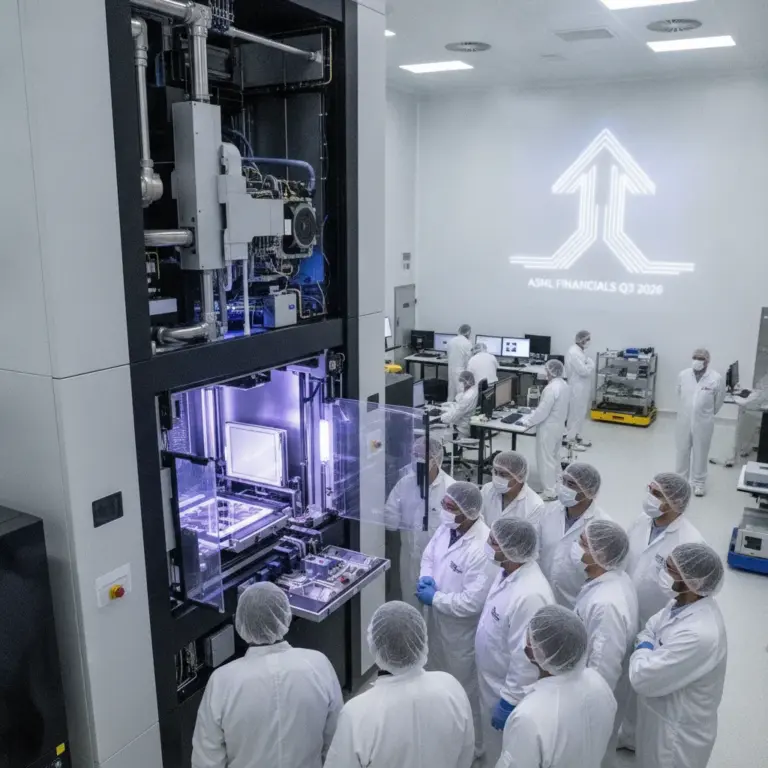
The global semiconductor landscape just received a significant shot of confidence thanks to the latest financial disclosures from ASML. As the sole provider of the extreme ultraviolet lithography machines required to print the world’s most advanced chips, the Dutch firm occupies a unique position in the supply chain. In its third quarter results for 2026, ASML revealed an impressive surge in revenue and earnings, reporting that it sold 113 new systems compared to just 66 during the same period last year. More importantly, leadership indicated that they are currently struggling to keep pace with overwhelming customer demand.

Chief Executive Officer Christophe Fouquet provided a bullish outlook during a recent earnings call, noting that major clients are seeing long term commitments that suggest demand for AI hardware will outstrip supply until at least 2028. This trend is so pronounced that some customers are already attempting to secure orders for 2029 and 2030. To accommodate this trajectory, ASML plans to expand its production capacity beyond its initial targets. For investors, this serves as a powerful signal that the infrastructure build out for artificial intelligence is nowhere near its peak.

This forecast provides a strong tailwind for industry heavyweights like Nvidia and Micron Technology. Because these companies rely on the machinery produced by ASML to create their high end GPUs and memory modules, the persistent shortage of supply creates a favorable pricing environment that supports aggressive growth. Despite this optimistic backdrop, both stocks recently experienced pullbacks driven by broader worries over interest rates and financing costs. However, analysts suggest these dips may provide an attractive entry point given the projected earnings trajectories for both firms.

Nvidia continues to see explosive potential, with expectations of doubling chip sales next year and maintaining massive revenue growth into fiscal 2028 within a constrained supply market. Similarly, Micron stands to benefit from widening gaps between logic and memory node availability, following a fiscal year where revenues soared over two hundred percent. With forward earnings multiples remaining competitive relative to the wider Nasdaq index, the latest updates from ASML suggest that any short term volatility in these stocks may be overshadowed by a multi year cycle of expansion.

Shares of Lam Research took a hit recently as investors reacted coolly to the company’s latest financial projections. While the chip equipment manufacturer continues to play a critical role in the global semiconductor supply chain, its most recent outlook failed to ignite excitement among Wall Street traders, leading to a noticeable dip in stock price.

The decline suggests that market expectations had grown too optimistic, leaving little room for anything less than stellar guidance. Despite the broader industry momentum driven by artificial intelligence and high performance computing, analysts noted that the current forecasts lacked the aggressive growth targets necessary to sustain the stock’s previous upward trajectory.

Industry insiders suggest that this volatility reflects a wider nervousness about when certain sectors of the chip market will fully recover. While demand remains strong for cutting edge nodes, some of the legacy segments where Lam Research operates have seen slower adoption rates, creating a mixed bag of results that left shareholders feeling uneasy.

Moving forward, the company faces the challenge of proving it can capitalize on next generation manufacturing trends while stabilizing its core revenue streams. For now, the market seems content to wait for more concrete signs of acceleration before betting heavily on another rally for the gear maker.

Sage Potash has significantly ramped up the potential of its Sage Plain project in Utah, announcing a massive jump in estimated resources following a productive summer of drilling. The company revealed that its total potash estimate has climbed to approximately 771.5 million metric tons, a substantial increase from the previous figure of 298.1 million. Most importantly, the firm has shifted 226.1 million metric tons into higher confidence categories, providing a much firmer foundation for future mine planning in San Juan County’s Paradox Basin.

To extract these minerals, Sage intends to utilize solution mining, a process where potash is dissolved underground and pumped to the surface as brine. This strategy received a boost recently when tests at the Peterson 1 well confirmed the presence of two saline water bearing zones. Chief Executive Officer Patricio Varas noted that securing reliable water sources is a critical part of the puzzle for solution mining, and these findings will now be integrated into the company’s broader engineering studies.

Looking ahead, the company is eyeing an initial annual production target of between 150,000 and 300,000 metric tons. While they move toward this goal through environmental studies and permitting processes, they plan to file a formal technical report within 45 days of their mid October announcement. If successful, the project could offer a rare domestic alternative for an industry currently dominated by foreign imports.

The push for local production comes at a time when U.S. fertilizer security remains volatile due to global politics. Currently, the United States relies heavily on Canada and Russia for its potash needs, while tensions with Belarus have historically disrupted supplies via sanctions. By establishing a foothold in Utah, Sage Potash hopes to reduce this dependence on international markets and insulate American agriculture from overseas trade disputes and geopolitical instability.

The traditional allure of gold is finding a second life in the digital age, according to a comprehensive new study conducted by the World Gold Council and Boston Consulting Group. Researchers suggest that the shift toward digital gold could spark an incredible surge in demand, potentially adding up to 700 billion dollars to the market as accessibility increases and consumer trust grows. While the current market is estimated to be worth between 45 billion and 55 billion dollars, there is significant room for expansion if the industry can successfully bridge the gap between physical bullion and virtual portfolios.

Much of this projected growth is expected to come from a demographic that has historically avoided precious metals. The data reveals that about 65 percent of this potential demand stems from individuals who do not currently own any gold, with younger investors leading the charge. In particular, awareness of digital gold options is far more prevalent among adults aged 25 to 34 compared to those over 55. This suggests that intuitive digital platforms are turning gold into an entry point for a new generation of savers rather than just a legacy asset for veteran investors.

However, scaling this opportunity requires more than just appetite from buyers. David Tait, CEO of the World Gold Council, emphasizes that robust infrastructure and standardized regulations are essential to ensure investors feel secure in their purchases. He argues that while shared systems are being developed to help issuers launch compliant products more efficiently, true liquidity depends on the entire industry adhering to uniform standards. Without these safeguards, the leap from curiosity to widespread adoption may remain stalled.

Despite these hurdles, early indicators show promising momentum for tokenized versions of the metal. These assets have seen their value quintuple recently, with trading volumes hitting record highs in early 2026. Urs Rahne of BCG believes that gold’s inherent physical nature actually makes it one of the most credible candidates for digitization. By blending timeless stability with modern convenience, proponents believe gold can evolve into a cornerstone of the global digital asset landscape.

Eli Lilly is doubling down on its integration of artificial intelligence with a new strategic partnership aimed at revolutionizing how drugs are delivered within the human body. Through a high stakes deal with Hong Kong listed METiS TechBio, the pharmaceutical giant hopes to refine the use of lipid nanoparticles, which act as microscopic vehicles transporting medicine to specific cells and tissues. If the collaboration hits its marks, METiS could receive up to 1.1 billion dollars in milestone payments.

The core of the project relies on a proprietary AI platform called AiLNP developed by METiS. By utilizing generative and predictive algorithms, the team aims to optimize ionizable lipids to ensure that therapeutic payloads reach their intended destinations more accurately and efficiently. While neither company has specified which exact diseases they are targeting first, leadership at METiS suggests that improving tissue specificity is essential for the next generation of complex medical treatments.

This move is part of a much broader trend for Eli Lilly, which has been aggressively building an AI ecosystem to accelerate drug discovery. Earlier this year, the company signed another major agreement with Insilico Medicine to leverage automated platforms for creating novel oral therapeutics. This pattern shows a clear shift toward tech bio, where traditional chemistry is augmented by machine learning to reduce trial and error in the lab.

Beyond these partnerships, Lilly is investing heavily in its own hardware infrastructure to maintain a competitive edge. The company recently deployed a massive supercomputing system powered by Nvidia GPUs, creating what has been described as one of the most powerful private AI factories in the pharma world. Between these internal tools and external collaborations, Lilly is positioning itself at the intersection of big data and biology to fundamentally change how patient care is developed.

Hudbay Minerals and Mitsubishi have officially given the green light to move forward with the construction of Copper World, a massive new mining operation located just outside Tucson, Arizona. The announcement follows a detailed feasibility study that positions the site as a cornerstone for future domestic metal production. Under the terms of their partnership, Hudbay maintains a seventy percent stake in the project while Mitsubishi holds thirty percent, with both companies aiming to bring the mine into full production by the latter half of 2029.

The scale of the project is ambitious, with projections suggesting an average annual output of 102,000 metric tons of copper during its first decade. This figure represents a significant increase over previous estimates and underscores the strategic importance of the region. For Hudbay specifically, the activation of Copper World combined with other regional growth initiatives is expected to double its total consolidated copper production to roughly 250,000 metric tons per year.

Financial architects behind the deal highlighted a disciplined approach to funding that limits immediate risk. Eugene Lei, Hudbay’s president and CFO, noted that a clever capital allocation strategy allows the company to fund only twenty five percent of the initial costs, with primary contributions deferred until 2028. Beyond the initial ten year window, there is potential to extend the mine’s lifespan up to thirty seven years through further expansion onto federal lands, provided necessary permits are secured.

This development is part of a broader effort by Hudbay to dominate the American Southwest’s mineral landscape. By combining this venture with its acquisition of Arizona Sonoran Copper Company and the associated Cactus project, Hudbay intends to establish what it describes as one of North America’s largest copper districts. Executives from both firms emphasized that securing these critical minerals within U.S. borders is essential for long term industrial stability and corporate growth.

The Canadian and Ontario governments have unveiled a massive two billion dollar investment aimed at unlocking the vast potential of the Ring of Fire. During a joint appearance on Wednesday, Prime Minister Mark Carney and Premier Doug Ford announced that the federal government will match Ontario’s own one billion dollar contribution over the next three years. This capital is specifically earmarked for essential road infrastructure, which is necessary to access some of the most strategic mineral deposits in North America.

This ambitious push is about more than just paving roads; it is a calculated move to insulate the domestic economy from volatile US trade measures and tariffs. By strengthening the supply chain for critical minerals like nickel, copper, and platinum, officials hope to secure Canada’s place in the global shift toward electric vehicles and advanced manufacturing. Prime Minister Carney emphasized that these investments are designed to protect current jobs while building a more independent and resilient economic future from the mine to the assembly line.

To ensure these projects don’t get bogged down in bureaucracy, the two levels of government are introducing a streamlined permitting process to speed up approvals. Beyond the immediate funding, they are identifying priority projects that can tap into existing federal accelerators and tax credits. A dedicated working group will also be tasked with engaging First Nations communities, ensuring that development includes local economic opportunities and respects environmental conservation goals through Indigenous protected areas.

Located deep in Northern Ontario, far beyond Thunder Bay, the Ring of Fire represents an enormous economic opportunity. Provincial estimates suggest that fully developing this remote region could spark twenty-two billion dollars in economic activity and create upwards of seventy thousand jobs over three decades. Combined with previous initiatives like the five hundred million dollar Critical Minerals Processing Fund, this latest agreement signals a determined effort by Premier Ford and his partners to keep as much value as possible within provincial borders.