Archive

November 6, 2026

Browsing

The tech sector is facing a rough ride today, and Nvidia is feeling the brunt of the volatility. Shares of the chipmaking powerhouse plummeted as much as nine percent during midday trading as investors began to question whether the massive wave of spending on artificial intelligence infrastructure will actually hold up into next year. This sudden shift suggests a broader unwinding of the popular AI trade, leaving shareholders anxious that the breakneck pace of expansion may finally be hitting a wall.

Much of the current nervousness stems from Nvidia’s unique position in the ecosystem. Beyond selling high-powered chips, the company provides an entire integrated platform of hardware and software designed to accelerate high-performance computing. However, some critics point to circular financing practices, noting that Nvidia has invested in various firms that then use those funds to purchase Nvidia products. This creates a fear that any dip in data center growth could trigger a domino effect, damaging both the company’s direct sales and its investment portfolio simultaneously.

Despite the red ink on today’s tickers, there are strong arguments that these fears are premature. During recent earnings discussions, leadership highlighted a supply-constrained outlook with expectations for seventy percent revenue growth heading into 2027. Because demand continues to outstrip available inventory, analysts suggest that if specific projects are delayed or canceled in one region, Nvidia can simply redirect its limited supply to other hungry markets across the globe where construction is still booming.

From a valuation standpoint, some observers believe today’s crash is creating a buying opportunity rather than signaling a collapse. With a forward price-to-earnings multiple currently sitting around fourteen according to FactSet Research, the stock is trading at a significant discount compared to the general market. For those who believe in the long-term trajectory of generative AI, entering positions after such a steep decline might prove to be a savvy move when viewed through a wider lens over the coming years.

Unity Software is starting to catch the eye of growth investors again as its stock price edges closer to a technical buy zone. After a period of volatility and strategic pivoting, the company is showing signs of stabilization driven largely by a renewed focus on profitability. Analysts are noting that the firm’s ability to trim excess costs while maintaining its core engine dominance is creating a more attractive entry point for those tracking momentum indicators.

The shift comes at a critical time for the game development giant, which has spent recent quarters streamlining its operations and rethinking its pricing models. By prioritizing efficiency over raw expansion, Unity has managed to improve its bottom line, signaling to Wall Street that it can balance innovation with financial discipline. This improved fiscal health is reflecting in the share price, which is now flirting with key support levels that often precede a bullish breakout.

While some cautious traders remain wary of broader tech sector swings, the current trajectory suggests that Unity is successfully shaking off previous headwinds. If the company continues to deliver strong earnings reports backed by sustainable margin growth, it could firmly establish itself back in the buy zone. For now, market participants are watching closely to see if this upward trend transforms into a long term recovery story.

Shares of Airbnb saw a significant boost today after the vacation rental giant reported quarterly earnings that comfortably beat analyst expectations. The company revealed a stronger than anticipated financial performance, driven largely by a persistent appetite for unique travel experiences and a steady increase in bookings across its global platform. Investors reacted positively to the news, sending the stock price climbing as confidence grows in the firm’s ability to maintain its market dominance.

Beyond the immediate numbers, it was the company’s optimistic forward looking guidance that really captured the attention of the trading floor. Management indicated that they expect continued growth through the coming quarters, citing expanded offerings and improved operational efficiencies. This strong outlook suggests that despite broader economic uncertainties, travelers are still prioritizing short term rentals over traditional hotel stays.

Industry analysts suggest that Airbnb is successfully pivoting toward more diverse lodging options and leveraging technology to streamline the host experience. By focusing on reliability and expanding their reach into emerging markets, the company has managed to insulate itself against some of the volatility seen elsewhere in the hospitality sector. As the travel industry continues its post pandemic evolution, these results signal a robust recovery for alternative accommodations.

Wall Street experienced a brutal shakeup this week as fears over potential new artificial intelligence regulations triggered a massive sell-off in tech and semiconductor stocks. The fallout was widespread, with the Dow Jones Industrial Average plummeting more than 1,800 points and the Nasdaq sinking deep into correction territory. For millions of Americans glancing at their 401(k) statements, these red numbers have sparked immediate anxiety about the safety of their long-term savings.

Financial advisors are urging investors to keep a cool head despite the turbulence. Mark J. White of Mark White Wealth Advisors warns that the greatest danger during such swings isn’t usually the dip itself, but the tendency to make impulsive, emotion-driven decisions. For younger workers, this slump might actually serve as a silver lining, allowing them to snap up shares at discounted prices through their regular contributions before the market eventually recovers.

However, the situation is far more precarious for those standing on the doorstep of retirement. Jay Duffy, managing partner at Frame Wealth, notes that people in their early sixties may find themselves trapped in aggressive portfolios meant for much younger investors. When retirees are forced to sell assets during a crash just to pay for daily living expenses, they face sequence-of-returns risk, a dangerous cycle that can drain a nest egg much faster than anticipated.

To mitigate these risks, experts suggest maintaining a healthy buffer of cash and conservative holdings to cover short-term needs without touching volatile stocks. Rather than panicking or ignoring the problem entirely, investors are encouraged to rebalance their accounts so their risk levels align with their actual retirement dates. Ultimately, a sturdy portfolio should be built to weather these storms without requiring a total overhaul every time the market hits a rough patch.

The United States men’s national team is preparing to return to action for the November international window, carrying the momentum of a perfect run of four consecutive victories. Manager Mauricio Pochettino has assembled a twenty five man squad tasked with navigating a high stakes two leg series against Haiti in the Concacaf Nations League quarterfinals. At stake is more than just progress in the tournament; a victory would secure a coveted berth in the 2027 Gold Cup.

While the roster features plenty of familiar faces, Pochettino is making it clear that tenure alone won’t guarantee a spot under his leadership. The Argentine manager is leaning heavily into the future, prioritizing raw potential and specific skill sets over current club status. This philosophy was most evident in his decision to leave some established staples at home while welcoming fresh blood into the fold, signaling a ruthless approach to building his ideal squad for the next cycle.

One of the biggest winners in this reshuffle is seventeen year old Mathis Albert. Despite struggling for playing time at Borussia Dortmund, where he has seen fewer minutes recently than he did during his first national team camp, Albert has earned Pochettino’s unwavering faith. The manager compared Albert’s situation to that of Gio Reyna, whom he backed despite limited appearances in Germany before Reyna eventually exploded onto the scene with standout performances for both club and country.

Pochettino described Albert as possessing a rare quality that is difficult to find elsewhere, insisting that the teenager can offer something unique to the American attack regardless of his lack of domestic minutes. By integrating Albert into a second consecutive senior camp, Pochettino is betting on instinct and long term development, hoping that trust from the national team will spark a resurgence for the youngster back in Europe.

Gold prices reached an unprecedented milestone on Wednesday, surging past the four thousand dollar mark per ounce as the dust settled on the US midterm elections. Spot gold climbed to 4,063 dollars, while silver followed suit with a jump to 52.32 dollars. This rally came alongside a dip in the US dollar index and falling treasury yields, reflecting immediate investor anxiety following a sweeping victory for Democrats who now hold control of both the House and the Senate.

The newfound legislative divide leaves President Donald Trump facing a Congress dominated by the opposing party for the rest of his term. Market analysts suggest that this political deadlock, combined with expectations of increased government spending and larger deficits under Democratic leadership, has shaken confidence in the greenback. Economist Peter Schiff noted that such a takeover could force the Federal Reserve to monetize government debt through quantitative easing, a scenario that typically drives investors toward safe haven assets like gold.

While some experts view this as a short term spike fueled by political uncertainty among Republican investors, others argue it signals a deeper systemic issue. Rich Checkan of Asset Strategies International pointed out that unless there are meaningful cuts to government spending, gold is likely to continue its upward trajectory regardless of which party holds power. Persistent overspending and rising national debt remain primary catalysts for those hedging against currency devaluation.

Further adding to the volatility, analyst Craig Hemke warned that anticipated investigations into the Trump administration and general political gridlock could further erode trust in the US Treasury market. While predicting exact market movements remains difficult given the complexity of global finance, many observers agree that until fiscal discipline returns to Washington, precious metals will likely remain an attractive alternative for worried investors.

All eyes are turning toward Parliament Hill this Thursday as the federal government prepares to table its latest budget. For investors eyeing Canada’s defense and aerospace sectors, the primary focus is whether high-level rhetoric regarding national security will finally translate into hard cash and firm contracts. This budget arrives shortly after the release of The Plan for a Stronger Canada, a landmark security strategy that signals a renewed commitment to upgrading the Canadian Armed Forces and bolstering Arctic sovereignty.

Despite these promising policy shifts, the stock market has shown some hesitation. Amar Pandya, a portfolio manager at PenderFund, notes that several prominent players saw their share prices dip in the third quarter even as their operational health improved. Companies like MDA Space and Kraken Robotics experienced significant slides despite showing encouraging signs of growth. According to Pandya, this disconnect serves as a reminder that immediate market volatility often diverges from long-term spending trends, suggesting that while shareholders may be nervous now, the fundamental business case remains strong.

The actual movement of money is already becoming visible in certain corners of the industry. Recent wins for firms like Magellan Aerospace and Draganfly indicate that specific procurement decisions are beginning to materialize beyond mere policy statements. Furthermore, MDA continues to find success through commercial channels, specifically via its work on Telesat’s Lightspeed network. This diversification suggests that Canadian space and defense firms aren’t solely dependent on domestic whims but are integrated into broader international and commercial cycles.

Looking ahead, analysts believe we are entering a multi-year investment cycle driven by aging equipment and NATO obligations that extend far beyond a single budget window. However, caution remains necessary as many major projects stay in the proposal phase rather than being fully funded commitments. While the general trajectory points toward increased spending on sovereign communications and surveillance, investors are encouraged to remain selective, distinguishing between theoretical pipelines and signed checks as Ottawa defines its financial priorities.

The mining industry is facing a looming crisis centered right in its own backyard, according to a new risk assessment from EY. The consultancy warns that operational complexity has become the primary threat heading into 2027, largely driven by the reality of aging mines and declining ore quality. As high-grade deposits vanish, companies are forced to deal with volatile mineral concentrations and fewer viable alternatives when disruptions occur, creating a precarious environment where small errors lead to massive financial losses.

These pressures are already manifesting in corporate balance sheets through soaring production costs. Major players like First Quantum Minerals and Codelco have seen their cash costs climb due to everything from equipment failures and seismic events to currency fluctuations. In the gold sector, physical instability is proving just as costly, evidenced by recent wall failures at Agnico Eagle Mines that could slash annual output by hundreds of thousands of ounces over the coming years. This fragility is further compounded by an unstable global supply chain for essential reagents like sulfuric acid.

To combat these headwinds, many operators are turning toward larger inventory stockpiles and enhanced digital tracking tools to gain better visibility over their supplies. While there is significant government funding pouring into critical minerals—reaching an estimated sixty five billion dollars for 2025—investors remain cautious, preferring stable jurisdictions and strategically vital materials over speculative ventures.

However, the rush toward modernization brings its own set of dangers. While AI promises higher productivity, experts warn that fragmented systems often create expensive organizational silos. Furthermore, as mines become more connected, they become more vulnerable to cyberattacks; current data suggests that two thirds of mining assets sit in a danger zone regarding security visibility. Combined with tightening environmental regulations and a growing need for community trust, the industry finds itself navigating a narrow path between technological ambition and fundamental geological decay.

Mining magnate Frank Giustra believes that regardless of who wins in Washington, the United States is spiraling toward a fiscal breaking point. Speaking recently at the 2026 New Orleans Investment Conference, the Fiore Group CEO argued that neither political party has shown the courage to tackle an unsustainable national debt that now exceeds forty trillion dollars. According to Giustra, the cycle of relentless deficit spending and soaring interest costs has created an inescapable trap, leaving policymakers with little choice but to lean on aggressive monetary interventions like quantitative easing.

This eroding confidence in the U.S. dollar is driving a global pivot toward hard assets, with gold emerging as a cornerstone of a shifting world order. Giustra noted that central banks across China and the Global South are aggressively stockpiling gold to insulate themselves from Western financial volatility and reduce their dependence on the greenback. This trend is backed by recent data showing record quarterly purchases by official institutions, fueling hopes for a parallel financial system where physical gold serves as the primary mechanism for settling international trade surpluses.

For those looking to protect their wealth, Giustra offered blunt advice regarding ownership, stating that anything other than physical gold is essentially worthless. While he views silver as a strong play for speculators due to its industrial utility, he sees gold as the ultimate long term sanctuary during periods of financial repression and currency devaluation. He even suggested that Canada should rethink its lack of official reserves by purchasing its own domestically produced gold rather than exporting every ounce to foreign markets.

Beyond precious metals, Giustra highlighted copper as the standout opportunity for mining investors today. He pointed to a perfect storm of systemic underinvestment and declining ore grades that have left the market starved for supply just as global demand continues to climb. In his view, copper represents one of the most obvious structural opportunities available because the timeline to develop new mines simply cannot keep pace with current needs, making it a critical asset in an evolving economy.

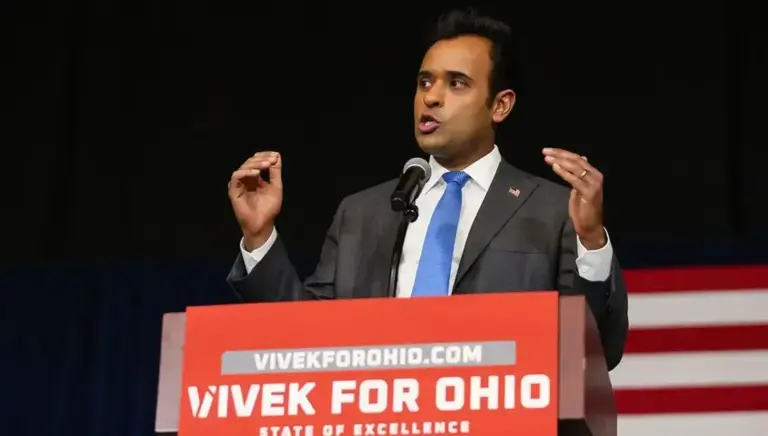
Florida Republican Gov. Ron DeSantis blasted failed Ohio Republican gubernatorial candidate Vivek Ramaswamy and his GOP handlers, arguing on a podcast that he wasn’t “in tune” with the working-class people of the state.

Biotech entrepreneur Ramaswamy lost his scandal-plagued race to Democratic candidate Amy Acton by 7.9 percentage points. Despite President Donald Trump’s endorsement and guidance from Vice President JD Vance’s top advisers, Ramaswamy lost amid a “blue wave” that produced major Democratic upsets across the country. The midterm elections were widely viewed as a referendum on Trump’s presidency.

But DeSantis, who ran for president in 2024 and is term-limited after 2026, shared on the Sage Steele Show that Ramaswamy bore some responsibility for his loss.

“I don’t know why they would have pushed him to be the candidate there. Oh, my mom’s from Youngstown. Ohio is a working class state, very blue collar. You know Vivek, he’s like a tech guy,” DeSantis said.

RAMASWAMY OUTLINES KEY CONTRASTS WITH DEM OPPONENT LESS THAN 100 DAYS OUT FROM KEY GUBERNATORIAL ELECTION

Ramaswamy, who previously ran for the Republican presidential nomination in 2024, is the founder of biotech company Roivant Sciences and anti-ESG investment firm Strive Asset Management. He also briefly co-led President Trump’s Department of Government Efficiency with Elon Musk.

He was warmly embraced by Trump, who endorsed him the same day Ramaswamy announced his candidacy. Trump had previously encouraged Ramaswamy to consider seeking Vance’s former Senate seat. Ramaswamy and Vance have known each other since their time at Yale Law School.

DeSantis criticized Ramaswamy’s support for a merit-based H-1B visa system, arguing that it likely further distanced him from Ohio’s blue-collar voters. Ramaswamy had said the current lottery-based system should be “gutted.”

‘He wants to bring in foreign workers on visas. That is not the type of person that’s going to sell.” DeSantis said.

Ramaswamy’s own companies have used the H-1B program, with Roivant Sciences having 29 H-1B applications approved between 2018 and 2023.

Meanwhile, Strive Asset Management, the investment firm he co-founded, moved its headquarters from Columbus to Dallas in 2025, months before Ramaswamy launched his campaign for Ohio governor. Ramaswamy said he was no longer involved in the company’s operations, but remained a major shareholder.

FOX NEWS VOTER POLL: 2026 MIDTERM ELECTIONS USHER IN A BLUE WAVE AS DEMOCRATS WIN CONTROL OF CONGRESS

“And I know he shot himself in the foot,” DeSantis said. “I know he did a lot of other stuff to make it a real landslide against him. But even with that, it’s like you know you got to meet the voters where they are on some of this stuff,” DeSantis said. “I think we would have done better in Ohio had we had a candidate that was more representative or more in tune with the interests of kind of these blue collar people that make the backbone of Ohio.”

Just weeks before the election, Ramaswamy’s campaign drew bipartisan outrage for using Democratic Gov.-elect Amy Acton’s estranged mother in an attack ad that called the Democratic candidate a “liar” and disputed her account of childhood poverty and homelessness.

The ad omitted that Acton had not seen or spoken to her mother since age 12, when her stepfather was arrested on charges of raping her. He pleaded not guilty but fled the area before trial, and court records show authorities continued seeking his arrest for years. Acton’s brother has said their mother remained married to him until his death in 2004.

Ramaswamy’s loss, alongside Republican U.S. Senate candidate Jon Husted’s loss to Democratic candidate Sherrod Brown by 4.9 percentage points, came just two years after Trump won the state by 11.2 percentage points.

DESANTIS CALLS GOP MIDTERM LOSSES ‘EXTINCTION-LEVEL EVENT’ — AND EXPLAINS WHY FLORIDA SURVIVED

In addition to criticizing Ramaswamy, DeSantis took aim at Congress, saying Republicans are now on the “defensive” and faulting lawmakers for failing to codify Trump’s executive orders into law.

“Last night’s elections did not only kneecap the last two years of the Trump administration, it basically ensures the four years after that are going to either be Democrat years where they have a trifecta or where you have a Republican president that is hemmed in and limited,” DeSantis said.

DeSantis also pushed back against any 2028 speculation.

SIGN UP TO GET THE POLITICS NEWSLETTER

“The only way that I would run for any office is if you can actually deliver big results,” DeSantis said. “I don’t want to just be a timepiece where I just sit there like a potted plant.”

Fox News Digital reached out to Ramaswamy for comment.