Archive

November 8, 2026

Browsing

Berkshire Hathaway significantly ramped up its share repurchase program in the third quarter, spending 9.6 billion dollars to buy back its own stock. This aggressive move represents more than double the amount spent in the previous quarter and pushes the company’s total buybacks for 2026 to roughly 14.4 billion dollars. The decision comes at a time when the conglomerate, led by CEO Greg Abel, is facing some headwinds regarding its bottom line.

Operating earnings from the firm’s wholly owned subsidiaries dipped by nearly six percent compared to last year, totaling around 12.7 billion dollars. Much of this slump can be attributed to a cooling insurance sector, where underwriting profits plummeted by forty three percent and investment income saw a fourteen percent decline. While these losses were partially offset by growth in the company’s energy, manufacturing, and railroad divisions, overall quarterly earnings still slid twenty eight percent due to a steep drop in investment gains from its vast stock portfolio.

Interestingly, investors seem unfazed by the dip in profitability. Berkshire shares have surged recently as traders rotate away from volatile tech stocks toward more stable value plays. In just the last month, Class A shares climbed over twelve percent while the broader S&P 500 fell by more than five percent. This trend has helped Berkshire outperform the general market throughout most of the year despite the volatility in its internal earnings reports.

As part of its cautious financial strategy, Berkshire continues to maintain an enormous mountain of cash, which grew slightly this quarter to over 377 billion dollars. Even with the increased spend on share buybacks, the company remains heavily liquid and steady in its core convictions. Its top five equity holdings remain unchanged, continuing to lean heavily on staples like Apple, Alphabet, American Express, Coca Cola and Bank of America.

The New York Mets have officially brought right-hander Robert Stock back into the fold, signing the veteran to a one year major league contract on Friday. According to reports from Anthony DiComo of MLB.com, the agreement is structured as a split contract, meaning Stock’s compensation will vary depending on whether he spends his time on the active big league roster or within the minor league system. The move provides the Mets with much needed pitching depth as they navigate their offseason strategy.

At nearly 37 years old, Stock brings a winding road of experience to Flushing. His career has seen him traverse across several MLB teams between 2018 and 2021 before taking a detour through South Korea, Mexico, and independent ball. Despite facing significant hurdles recently, including surgery for thoracic outlet syndrome last March, Stock showed flashes of resilience when he joined the Mets’ active roster in August. Though his numbers were modest over thirty innings of work, his velocity remained impressive, consistently hitting near ninety six miles per hour.

While a late season injury involving finger numbness cut his campaign short in September, the decision to re-sign him suggests that the Mets are optimistic about his long term health. By placing him on the forty man roster now, the team gains some strategic flexibility regarding how they manage their personnel heading into spring training. Because Stock is out of minor league options, any attempt to send him down would require designating him for assignment.

The specific financial structure of the split deal may actually serve as a safeguard for New York. A higher guaranteed salary for the major league portion could make other teams hesitant to claim him off waivers should he be designated for assignment, increasing the likelihood that he clears waivers and remains in the organization. For now, Stock serves as a versatile insurance policy who can slide into either the starting rotation or the bullpen as the team continues its pursuit of additional arms this winter.

Wall Street is rediscovering the appeal of stability through Berkshire Hathaway as investors scramble for safety amidst a cooling artificial intelligence rally. After trailing the broader market following Warren Buffett’s transition away from the chief executive role last year, Berkshire’s Class B shares have surged, comfortably outpacing the S&P 500. This shift reflects a classic rotation where traders abandon volatile tech stocks in favor of tangible assets, mirroring previous periods of economic turmoil such as the aggressive interest rate hikes seen in 2022.

Despite the stock price surge, the internal numbers tell a more complicated story. Berkshire’s actual investment gains plummeted nearly half compared to the previous year, falling to 9.4 billion dollars according to its latest quarterly filings. While staples like Apple and Coca Cola remain central to the portfolio, Greg Abel has been aggressively managing the firm’s liquidity. Under Abel’s leadership, the company has significantly ramped up share buybacks, spending billions of dollars to repurchase its own stock throughout the latter half of the year.

Beyond the trading floor, Berkshire continues to bet heavily on the physical world. From railroads and candy shops to a recent multi billion dollar acquisition of home builder Taylor Morrison, the conglomerate is leaning into traditional industry just as others chase digital ghosts. These bets are paying off across energy and manufacturing sectors even as insurance underwriting struggles.

This pivot comes at a critical time for the wider economy. While governmentSpending on data centers and power grids initially fueled growth, shifting political landscapes in key states like Texas and Georgia may soon throttle that momentum. As those headwinds mount, many investors seem convinced that there is nowhere safer than a diversified empire built on bricks and mortar rather than algorithms and chips.

The Seattle Mariners are continuing to refine their roster as they push toward Opening Day, focusing heavily on filling critical roles within the dugout. The team has recently made moves involving Tanner Swanson, Jacob Young, and Robert Stock, signaling a strategic effort to bolster both the bullpen and the outfield depth. These acquisitions come at a pivotal time as the front office works to ensure there are no weak links in the lineup before the season officially kicks off.

While these veteran additions provide immediate stability, the organization is also seeing promising growth from its younger core. Infielder Cole Young has notably avoided the dreaded sophomore slump, with recent reports highlighting how his disciplined work ethic has translated into tangible progress on the field. This blend of seasoned experience and emerging youth suggests that Seattle is building a balanced squad capable of weathering the long grind of a sixteen two game schedule.

Beyond the player personnel changes, the atmosphere around the club remains electric following the appointment of their new skipper. As other teams in the division struggle with leadership voids or experimental hiring processes, the Mariners appear settled and focused. Between constant contract updates and active management of injury reports, the organization is operating with an urgency intended to maximize their window of contention this year.

Wall Street experienced a jarring reversal this week as the tech heavy Nasdaq saw a staggering 2.5 trillion dollars vanish in a single day. While markets initially reacted with optimism toward the Democrats’ midterm victories, that mood soured quickly by Thursday. Investors began to fear that the new political landscape would bring tighter regulations and obstacles for the artificial intelligence sector, potentially stalling the massive infrastructure buildout that has driven growth for years.

Much of this anxiety stems from specific policy promises made during the campaign trail. In Texas, Governor elect Gina Hinojosa signaled her intent to temporarily halt new data center construction and roll back tax incentives for tech firms. Such moves have sent ripples through the investment community, raising questions about whether the unchecked expansion of AI hardware will face significant legislative headwinds across various states.

However, analysts suggest that politics was only the catalyst for a much deeper systemic issue involving excessive debt. Many hedge funds had borrowed heavily to amplify their bets on the AI boom using high levels of leverage. When prices started to dip due to political uncertainty, these investors faced urgent margin calls from lenders demanding more collateral. This forced them to sell off large chunks of their holdings regardless of price, creating a feedback loop where selling triggered further price drops and subsequent liquidations.

Despite the carnage, some experts believe this volatility is more about financial overextension than a fundamental collapse of technology values. Jamie Cox of Harris Financial Group noted that while those who got too far over their skis are currently suffering, the long term trajectory remains intact as companies look to optimize existing facilities. Still, the episode serves as a stark reminder that when an entire sector is built on borrowed money, even a small crack in confidence can lead to a landslide loss in value.

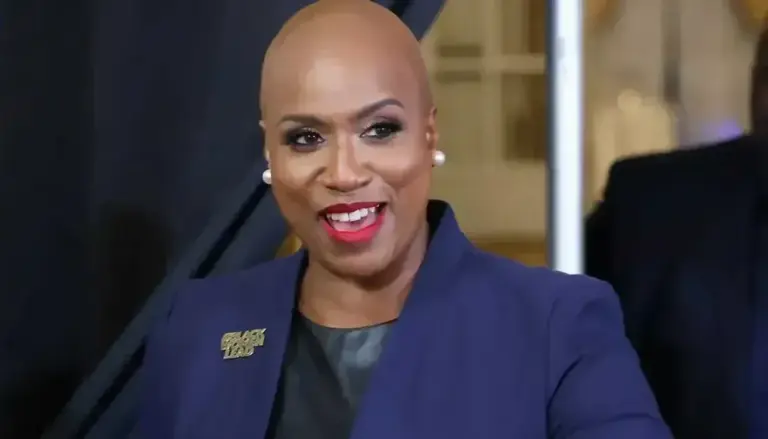
Rep. Ayanna Pressley, D-Mass., is pressing her party to wield their power to push far-left policies such as passing Medicare for All and reparations, and abolishing U.S. Immigration and Customs Enforcement (ICE).

During remarks on Tuesday, Pressley declared, “Alright, now as I close I have a message for my colleagues in the House who are likely watching. Democrats, when we have the power, you have to use it. Democrats, can you hear me now? When we have the power we have to use it.

“Now, please don’t tell me about a majority, show me a majority. Show me a people-powered majority with a mandate for justice, with a mandate for compassion, with a mandate for progress,” she declared.

‘SQUAD’ RAKES IN RECORD $2.35M WHILE SLAMMING THE DOOR ON COP DONATIONS

“Democrats, don’t just talk about healthcare justice, pass Medicare for All. Democrats, don’t just talk about abortion justice, pass the EACH Act, and repeal the Hyde Amendment. Democrats, don’t just talk about black lives mattering, enact reparations now. Democrats, don’t just talk about ending ICE’s terror, take every last dollar from them and abolish ICE,” the congresswoman continued.

Pressley, a member of the progressive cadre of House Democrats known as “The Squad,” has served in the chamber since early 2019.

WHAT THE 2026 MIDTERM RESULTS MEAN FOR CAPITOL HILL

Republicans suffered an electoral rout during the midterm elections, resulting in the loss of the House and Senate majorities, though President Donald Trump can veto any legislation the Democratic-controlled Congress sends to his desk during his final two years.

“The fascist occupant of the White House tried his hardest to end DEI and has pushed Black women out of the workforce. Now, Black women are flexing their power and poised to lead at every level of government. And we’re bringing friends,” Pressley said Wednesday on X.

SCANDAL-PLAGUED ‘SQUAD’ REP CRUISES TO DEMOCRATIC NOMINATION WITH NO GOP ROADBLOCKS IN VIEW

In a statement provided to Fox News Digital on Friday, White House spokeswoman Allison Schuster said, “President Trump promised to end divisive, racist policies and restore merit and efficiency. DEI ran rampant during the Biden Administration, and Americans ultimately paid the price for these destructive policies with a restricted labor pool, higher operational costs, and workforce inefficiencies. The Trump Administration will always promote equal treatment under the law for every American, regardless of race or ethnicity.”

The Republican National Committee did not immediately respond to Fox News Digital’s request for comment on Friday.

BROOKLYN, N.Y. — With New York City Mayor Zohran Mamdani escalating his opposition to ICE, federal agents continue to carry out high-stakes street arrests that one of the agency’s top officials says could be avoided if the city cooperated with federal authorities instead of enforcing its sanctuary policies.

Fox News Digital embedded with ICE agents last Thursday, getting a rare, firsthand look at the surveillance, tense stakeouts and split-second decisions behind arrests on Brooklyn streets — while riding along with the agency’s top local enforcement official as he blasted city and state leaders over policies he says put officers and the public at risk.

The early-morning operation saw agents move in on two men, handcuffing them and rushing them into unmarked SUVs. The first arrest was over in seconds. The second turned into a tense struggle.

MAMDANI CALLS ICE A ‘ROGUE’ AGENCY AFTER NYC SHOOTING, CLAIMS AGENTS VIEW LAW AS ‘MERELY A SUGGESTION’

Behind the wheel was Ken Genalo, head of ICE’s Enforcement and Removal Operations (ERO) in New York City, who accused Mamdani, Gov. Kathy Hochul and the City Council of keeping dangerous offenders on the streets.

“100% all of this is about politics. It is not about public safety,” Genalo said as he sat in his vehicle while his team staked out a Georgian illegal migrant charged with sexual abuse.

He argued that sanctuary laws force ICE to track down suspects who should have been handed over to agents at local jails. Instead, agents have to try and apprehend migrants on city streets.

“They don’t acknowledge the victims, they don’t acknowledge the angel families, those that unfortunately have suffered severe loss due to illegal alien crime,” he said.

The operation came less than a week after Mamdani released a Spanish-language video advising New Yorkers on how to respond to ICE agents, as tensions flared following the shooting of a Dominican migrant who authorities say tried to ram officers with his vehicle. The migrant had been in the U.S. for just three years but had already racked up a lengthy rap sheet for theft, robbery, assault, drug and weapons offenses, according to DHS.

The Brooklyn arrests came amid a wider enforcement push, with ICE arresting nearly 2,200 illegal migrants during a statewide crackdown in August, known as Operation Rotten Apple.

But the ride-along with ICE revealed what those figures cannot: hours of painstaking surveillance, careful planning and tense waiting — all for arrests that can be over in seconds and quickly escalate.

WATCH: NYC ICE official rips Mamdani, sanctuary laws after tense street arrests

DHS BOSS REVEALS OVAL OFFICE PLAN TO ‘WITHHOLD FUNDING’ FROM SANCTUARY CITIES AFTER AGGRESSIVE NEW YORK BUST

Inside ICE’s predawn raids

Before dawn Thursday, more than a dozen armed ICE agents gathered at a secret Brooklyn location, wearing protective vests marked “ERO.”

Commanders briefed them on several targets and the potential risks: one might be armed, another was an amateur boxer. The stark warnings offered a glimpse into the dangers agents face as they head onto the streets to carry out arrests.

Agents checked their gear, attached body cameras to their vests and hit the streets around 5:50 a.m.

Genalo drove an unmarked SUV, monitoring radio chatter and explaining how agents tracked their targets, what could go wrong and why timing was critical.

The first target was Nika Tkeshelashvili, 40, a Georgian national who ICE said entered the United States illegally through the southern border in January 2023 and was arrested in September on a first-degree sexual abuse charge. The charge remains pending.

His next immigration court hearing wasn’t until October 2028 — a five-year wait that drew disbelief from Genalo.

As the SUV rolled through Brooklyn, Genalo explained how agents establish a “pattern of life” — studying a suspect’s routine to determine when and where to make an arrest.

In Tkeshelashvili’s case, the intelligence was surprisingly mundane. Agents believed he regularly emerged between 7 a.m. and 7:30 a.m. to move his car and avoid a parking ticket.

Unmarked ICE vehicles took up positions along nearby streets while Fox News Digital waited with Genalo roughly half a block away, with a clear view of the apartment building where the Georgian national was expected to emerge.

But as the minutes ticked by, he was nowhere to be seen. Genalo remained unfazed.

Meanwhile, daylight crept across the neighborhood, bringing commuters, schoolchildren and growing traffic. Genalo explained that darkness was an ally during these operations, but as the streets filled, a discreet arrest became harder.

MAMDANI DEMANDS TRUMP RELEASE ILLEGAL IMMIGRANT SHOT BY ICE AGENT AS PROTESTS ERUPT IN THE BRONX

Even weeks of surveillance could not guarantee Tkeshelashvili would appear, Genalo explained. If he stayed inside, agents might have to return another day.

Then, at 7:57 a.m., a voice broke over the radio.

“Target one just stepped out with a cigarette going towards the car if I’m not mistaken,” an agent reported.

Genalo raised his hand and pointed toward the radio. “I think that’s ours,” he said as more chatter crackled through the SUV.

“He’s wearing a black vest, red shirt, red hat,” another agent radioed.

“Team two, that’s Tango. That’s Tango,” an agent called out.

Within moments, agents converged on Tkeshelashvili in the middle of the street. Genalo accelerated toward the scene, the arrest unfolding through the SUV’s windshield.

By the time Fox News Digital pulled up, officers had already handcuffed Tkeshelashvili and were moving him into a waiting vehicle. He remained calm and said little. Within moments, the team was moving on toward Target 2.

Genalo hailed the arrest as “textbook” and “flawless,” praising the intelligence, timing and surprise that allowed agents to secure their target without a struggle.

Speed, he explained, was critical.

Minutes earlier, we heard over Genalo’s radio that another ICE team had encountered agitators blowing whistles, shouting and warning locals that federal agents were nearby.

The team was pursuing an Ecuadorian migrant who faced sexual misconduct charges involving a child, Genalo said, but the agitators disrupted the operation.

“Why would you protest that we’re trying to arrest this individual?” Genalo said.

A tense struggle on Brooklyn streets

As we pulled away from the first arrest scene, Genalo briefed us on the next target: Yves Frantz Augustine, 45, a Haitian national who ICE said entered the U.S. legally in 1997 but overstayed his visa. Ordered deported in 2006, he remained in the country, later amassing a criminal record that included an assault conviction for which he served seven years in prison, along with weapons offenses and a terroristic threat case, according to ICE.

Augustine previously served seven years in prison for assault, but ICE’s attempt to deport him in 2011 during the Obama administration failed because Haiti would not issue the necessary travel documents, Genalo said.

ICE tried to take him into custody after further arrests, but New York authorities refused to hand him over despite three detainer requests, according to Genalo.

Agents faced a major concern during this operation: Augustine was taking a child to school.

Genalo explained that agents would wait until Augustine drops off the child before moving in, saying ICE policy is to avoid making arrests near schools or in the presence of children.

Another team of agents was tracking Augustine from cars and on foot, relaying updates over the radio as Brooklyn’s morning rush gathered pace.

Genalo pulled up alongside the curb, explaining that Augustine was expected to walk straight toward our SUV. We waited as traffic rolled past and officers closed in on his position.

At approximately 8:26 a.m., the go-ahead came over the radio.

Agents quickly surrounded Augustine just ahead of our SUV, grabbing his arms as they tried to handcuff him.

“Don’t move! Police! Let me see your hands!” an officer shouted, drawing his weapon.

“We have a warrant for your arrest!” another announced.

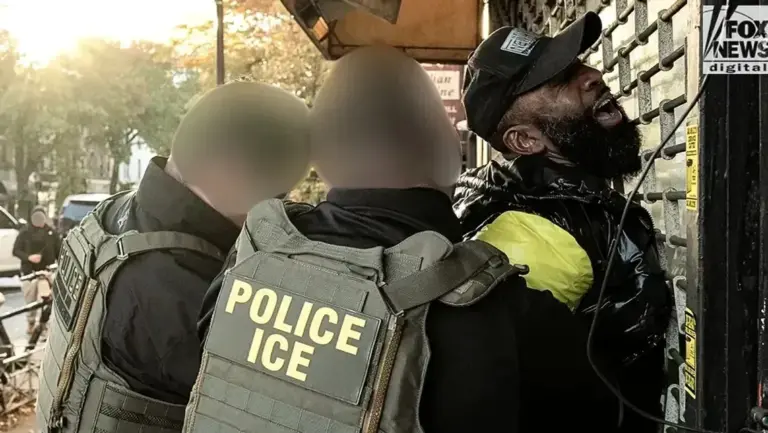
But Augustine refused to put his hands behind his back, prompting the agents to press him against the metal shutters of a closed storefront as they struggled to cuff him.

“No, no, no, no,” Augustine shouted.

“Sir, don’t fight,” an officer warned, while a third appeared and tried to calm him.

“Just put your hands behind your back, sir,” the third agent said, placing his hand on his shoulder.

As agents led Augustine away in handcuffs, his jacket slipped down, revealing the words “it’s all a trap” emblazoned across the back of his shirt. The front read “NOCOMP.”

He continued pulling back as agents moved him toward a waiting SUV, pleading for his children.

“Think about my kids,” he cried out, according to footage recorded by Fox News Digital.

Appearing stunned, he continued questioning the arrest.

“A warrant for what?” he shouted and asked to call his wife before claiming he was now a U.S. citizen. An officer showed him the warrant and gave him time to read it before placing him in the SUV.

Genalo disputed the citizenship claim, citing Augustine’s 2006 deportation order.

The arrest took roughly four minutes, far longer than the first, before agents secured Augustine and cleared the street.

Back in the SUV, Genalo said Augustine’s resistance forced officers to use additional restraint techniques, explaining that agents typically move detainees to a secure location before transferring them to an ICE processing facility.

“We want to get in, make the arrest, and get out as fast as possible,” Genalo said.

He also rejected accusations that ICE agents abduct or disappear people, defending the speed of the arrests as a safety precaution.

“We don’t kidnap people, we don’t disappear people. We arrest people,” he said.

ICE vs. City Hall

For Genalo, the arrests reflected a wider battle over law and order — with ICE trying to remove dangerous offenders while city leaders refuse to cooperate and protesters work to disrupt operations.

“You have murderers on the street. I mean, that by itself is absolutely amazing that you can say you’re keeping the community safe by releasing murderers back on the streets,” he said.

Genalo said both Brooklyn suspects had previously been in local custody, but authorities ignored ICE requests to hand them over. The refusals, he argued, wasted taxpayer money and put officers, suspects and the public at risk.

During the stakeout for Tkeshelashvili, agents feared their cover was blown when an NYPD patrol car appeared, adding another hurdle amid limited cooperation with local police. Genalo suggested a resident may have called police, but the concern was quickly resolved.

Genalo laid much of the blame on Mamdani, Hochul and the City Council, accusing them of putting political ideology ahead of public safety while allowing offenders to return to the communities they claim to protect.

“They’re criminals that committed heinous crimes. And they should not be in the community,” Genalo said of many of the migrants ICE has been apprehending.

For Genalo, a Brooklyn native and 34-year law enforcement veteran deployed to Ground Zero with a special response team after 9/11, the breakdown in cooperation is personal. He recalled when ICE worked closely with local police and had its own unit at Rikers Island, taking more than 100 people a week into custody directly from the jail. Today there is no cooperation.

Genalo blamed former Mayor Bill de Blasio for ending the arrangement and said former Mayor Eric Adams tried to restore cooperation but was hamstrung by the City Council. Mamdani, meanwhile, has called for ICE to be abolished and publicly opposed its enforcement operations.

Genalo repeatedly fumed over New York City’s sanctuary policies throughout the ride-along, challenging city leaders to put the issue on the ballot and let New Yorkers decide whether police should cooperate with ICE.

“Let the residents decide,” he said.

A bipartisan push for a public vote in 2024 and 2025 went nowhere. Genalo suggested council members feared the result.

Genalo also criticized anti-ICE protest networks that monitor federal vehicles, alert residents and mobilize protesters when officers are spotted.

Even before Thursday’s operation began, a car carrying civilians circled the agents’ secret meeting point and parked nearby, raising suspicions that its occupants might be spotters. Officers kept watch until the car drove away.

“I give a lot of kudos to the men and women of ICE in New York City and nationwide staying professional in spite of the agitation that they’re facing,” he said.

Despite his blistering criticism of Mamdani and the city’s sanctuary policies, Genalo said he was willing to talk with the mayor.

“I just wish we could sit down and collaborate and come to an agreement because we have the same job to do, and that’s to keep the people of the community of New York City safe,” Genalo said.

“The men and women of ICE in New York City will not waver,” he said.

This post appeared first on https://www.foxnews.com

President Donald Trump said he has ordered the Department of Justice to open an investigation into instances of Democratic lawmakers “threatening” to impeach Attorney General Todd Blanche, among others.

The announcement, which was made via a Truth Social post Saturday afternoon, came after the Democrats retook control of the House and Senate in the midterm elections, winning strong majorities in both chambers of Congress.

“The Democrats are going around threatening a lot of people, including the Attorney General of the United States, and others, with Impeachment and many other forms of punishment, even though they admit they have no reason to do so,” Trump wrote.

Since Election Day, two House Democrats — Reps. Hank Johnson, D-Ga., and Deborah Ross, D-N.C. — have publicly said they would support impeaching Blanche.

HOUSE GOP ERUPTS AT STEPHEN MILLER AS TRUMP ELEVATES HIM AFTER MIDTERM MASSACRE: ‘MEGALOMANIAC’

“I personally believe that the offenses of Todd Blanche demand that he be impeached and convicted and removed from office,” Johnson said Thursday in an interview on SiriusXM’s “The Dan Abrams Show.”

Ross went on host Dan Abrams’ radio show shortly after Johnson and said she supported impeaching Blanche as well, but thought Democrats “should start with Hegseth.”

In his post, Trump denied that any “impeachable acts” had been committed by Blanche or any other administration officials. He didn’t mention Johnson or Ross by name, nor did he mention the fact that Thomas Massie, R-Ky., will likely reintroduce impeachment articles against Secretary of War Pete Hegseth on Monday.

Trump named only one Democratic politician, Sen. Elissa Slotkin of Michigan, in his post. He accused her of saying she would “go after all young people that believe in Republican Values.”

TRUMP CALLS OUT SENATE REPUBLICANS AFTER MIDTERM LOSSES

Trump appears to have been referring to comments Slotkin made on Oct. 13 at the University of Chicago about wanting to pursue “signature cases” against people who “enabled” Trump.

“I want young people coming out of school to say, ‘Should I go work for the Trump administration? Like, that sounds fun, I might get an opportunity.’ I want them to be like, ‘Lord, that might be buying myself a ton of problems that I don’t want, and so let me avoid participating in that,'” Slotkin said. “I want that deterrence message sent.”

Trump also said that Democrats have been threatening Republican donors “with imprisonment” because of their views.

The president did not identify the donors that have allegedly been threatened. Democrats have, however, signaled they plan to investigate some major Republican donors and corporations when they assume control of Congress, Reuters reported this week. This could include donors to the White House ballroom.

Trump concluded his post by saying “these EXTORTIONISTS” should be imprisoned and that he wanted the DOJ to investigate the alleged actions as a “criminal act.”

A Biden-appointed federal judge ordered ICE’s Denver field office director to appear in court Monday amid concerns that immigration authorities violated judicial release orders by immediately re-arresting detainees, including at least one instance outside a detention facility.

Nathan Rasper has been summoned as part of an inquiry involving 14 people who were re-arrested after being released from immigration detention. The Department of Homeland Security (DHS) maintains that ICE complied with lawful court orders and that a judicial release order does not permanently shield individuals from immigration enforcement.

“When an illegal alien is ordered released by a judge, that does not immunize the alien from immigration enforcement for all time,” DHS said in a statement to Fox News Digital. “ICE may seek to re-arrest the alien in a way that complies with the judicial decision. To suggest that ICE cannot do this is nothing short of sabotage.”

The Nov. 5 order issued by U.S. District Judge Charlotte Sweeney followed an earlier ruling requiring the government to identify every case in Colorado since Oct. 27 in which ICE re-detained someone within 12 hours of a court-ordered release. Federal officials subsequently identified 14 petitioners who had been re-arrested after being released, but the filing did not provide the precise timing of when the re-arrests occurred. She directed officials to provide the exact dates and times of those releases and re-arrests and identify any additional individuals immediately detained following court-ordered releases.

OBAMA, BIDEN JUDGES DRAW FRESH FIRE AS TRUMP’S IMMIGRATION COURT CLASHES HEAT UP: ‘ALMOST IMPOSSIBLE’

The additional reporting requirements followed a Nov. 4 hearing in which Sweeney questioned whether ICE was circumventing judicial orders by briefly releasing detainees before immediately taking them back into custody. At that hearing, she ordered Rasper to appear at a follow-up hearing Monday to address the agency’s practices.

The inquiry stems in part from the case of Ramon Quintero Alvarez, who was released from immigration detention on Oct. 27 before ICE immediately took him back into custody, according to a government court filing.

In a Nov. 3 court filing, federal government attorneys said they would not submit a legal brief defending the lawfulness of Alvarez’s continued detention.

The filing prompted Sweeney to convene the Nov. 4 hearing at which Assistant U.S. Attorneys Andrew Soler and Kevin Traskos appeared alongside ICE Assistant Field Office Director Nichole Black, who testified under oath about the circumstances surrounding Alvarez’s re-arrest.

APPEALS COURT BLOCKS TRUMP ADMIN FROM HOLDING MIGRANTS WITHOUT BOND FOR OVER 90 DAYS

At a Nov. 4 hearing, Sweeney ordered Alvarez be released and barred immigration authorities from detaining him again unless the government demonstrated, by clear and convincing evidence at a bond hearing, that he posed a flight risk or danger to the community.

The government must submit the additional information requested by Sweeney by 8 a.m. Monday, ahead of Rasper’s scheduled court appearance later that morning. The proceedings could shed light on ICE’s compliance with judicial release orders, but Sweeney has not indicated whether she intends to pursue contempt proceedings.

The dispute comes as ICE faces similar legal challenges across Colorado, where other Biden-appointed federal judges, including U.S. District Judges Nina Wang and S. Kato Crews, have presided over cases involving disputes over immigration detention and court-ordered releases.

Fox News Digital reached out to the U.S. Attorney’s Office for the District of Colorado for comment.

Some troops have gone a year without hot water. Others are sleeping in their cars to escape barracks without air conditioning. And some are asking for little more than drywall, spackle and paint so they can make repairs themselves.

Those are among the conditions Medal of Honor recipient Dakota Meyer says he has encountered while touring military installations on a mission from War Secretary Pete Hegseth: Fix a barracks system plagued by decades of neglect.

“I would tell you that there’s only a couple that I’ve seen that are good,” Meyer told Fox News Digital in an interview Thursday.

DAKOTA MEYER TALKS SERVICE, BLASTS CONTROVERSIAL DESIGN FOR GLOBAL WAR ON TERROR MEMORIAL

Meyer, who serves as a senior advisor to the Pentagon’s Barracks Task Force, has visited more than eight installations across the Army, Navy, Air Force and Marine Corps since taking on the assignment and plans to visit 30 before the end of the year.

“What I thought was gonna be a professional job very quickly turned into personal,” Meyer said.

At one installation, Meyer recalled asking a 19-year-old service member what she would change about her living conditions if she could “wave a magic wand.”

“If she could just have a hot shower,” Meyer recalled. “It’s absolutely heartbreaking.”

The Pentagon’s barracks problems long predate Hegseth and have survived repeated attempts at reform. 

A sweeping 2023 Government Accountability Office investigation documented serious health and safety hazards and found that the department lacked reliable information about the condition of its own barracks, could not determine how much of its facilities spending went toward them and provided insufficient oversight.

Congress and the military services have since committed billions toward improvements, including initiatives ranging from the Marine Corps’ Barracks 2030 to a Navy overhaul of unaccompanied housing. Yet serious problems persist. As of this year, 12 of GAO’s 31 recommendations remained outstanding.

Hegseth has sought to centralize the effort under a department-wide task force and accelerate improvements, and Meyer said the secretary has made clear that identifying problems is no longer enough.

“The secretary has made it clear to me he doesn’t expect me to observe this, study it or to make it better. He expects me to fix it,” Meyer said. “And that’s exactly what we’re going to do.”

Meyer, the only Medal of Honor hero to reenlist after receiving the award, said one of his first requests was for Hegseth to give the task force an “authoritative role,” rather than simply create another layer of oversight.

The goal, he said, was to give the team the ability “to go out and make decisions, to be able to have impact, to be able to make change and to be able to direct where that funding goes and how fast it gets to our service members.”

EXCLUSIVE: HEGSETH TO DOUBLE CUTS TO GENERALS, ADMIRALS IN MAJOR PENTAGON SHAKEUP

Meyer argued the problem is not simply a lack of money. Funding shortfalls, continuing resolutions and years of deferred maintenance have all contributed, he said, but so have layers of contracting rules and bureaucracy that can slow even relatively basic repairs.

A separate watchdog review found the Pentagon facing a $285 billion maintenance backlog across its broader military facilities’ portfolio, underscoring the scale of the department’s infrastructure challenges.

“When you look at the contracting aspect, it’s easier for people to say no,” Meyer said.

Funding is also part of the problem, according to Meyer, who pointed to Congress’ failure to enact full-year defense appropriations for fiscal 2027. The Pentagon is operating under a continuing resolution through Dec. 11, which generally funds ongoing programs at prior-year rates while lawmakers negotiate a broader spending package.

“When you can’t get a budget, when you’re waiting on Congress to pass a budget, to be able to get the funding there, I mean, that is a huge issue,” Meyer said.

But he also argued that the Pentagon has too often measured progress by how much money has been obligated or put under contract, rather than whether troops actually see improvements in their living conditions.

“Our service members don’t, they don’t live in our budget lines,” Meyer said. “They live in the rooms that those budget lines are there to impact.”

For Meyer, that has meant getting out of Washington and hearing directly from the troops living with the consequences.

“You can’t fix these problems or understand these problems by standing on the carpet of the Pentagon,” he said. “You’ve got to go out there and talk to these service members.”

What he has heard, Meyer said, is striking partly because of how little troops are asking for.

“They’re asking for a hot shower. They’re asking for a place to wash their clothes. They’re asking for a door that locks. They’re asking to be able to go to sleep in a place that doesn’t have mold. I mean, they’re asking for light bulbs.”

“They’re willing to be part of the solution,” he added.

Meyer stopped short of placing the blame solely on installation commanders, saying many want to improve conditions but have been constrained by a system that has normalized poor barracks for years.

“I think this is a multidimensional problem, and it’s complex,” he said. “I think that you have commanders out there that want to take care of their service members. I’ve seen that across the board. But … they still have to have the ability to do that.”

Meyer was far less forgiving of previous Pentagon leadership, arguing that years of investments and reform initiatives had failed to translate into adequate living conditions for troops.

“Don’t kid yourself,” Meyer said. “In the past … it wasn’t a priority to the leadership.”

Previous administrations and military leaders did launch barracks improvement efforts and devoted billions of dollars to construction, renovation and maintenance, even as government watchdogs continued to document serious deficiencies.

Meyer said Hegseth has made the issue a personal priority.

“We have the secretary of war who is putting people first, and he’s not just saying that. He’s doing it through his actions,” Meyer said.

Meyer has put his own name on whether the latest effort succeeds, saying previously that if the barracks aren’t fixed, there is “only one person to blame” — himself.

Asked what “fixed” would actually look like, Meyer offered a simpler standard than any Pentagon metric.

“People are living in places that I would be OK for my daughters living in,” he said.